As war once again escalates in the Middle East, young people are not encountering these events through evening news broadcasts or carefully contextualized briefings. They are experiencing them in real time, through algorithmically driven feeds that collapse geopolitics into clips, memes, and outraged commentary.
For many teens, images of missile strikes, civilian casualties, antisemitic and Islamophobic rhetoric, and viral claims about who is to blame appear in the same scroll as homework reminders and inside jokes with friends. They are being pushed to react before they have had time to learn.
Or Initiative was launched precisely for moments like this.
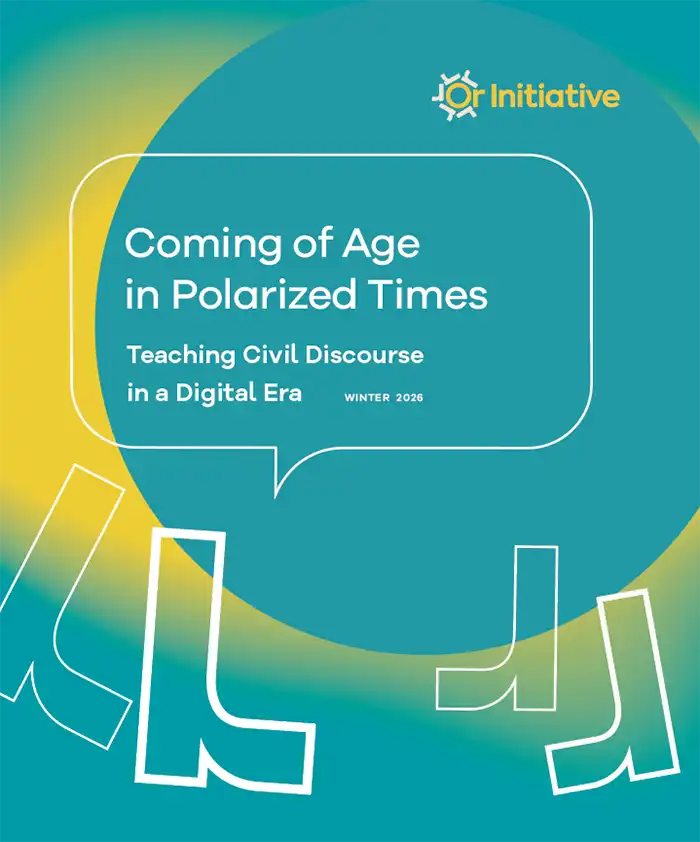
Over the past year, we have been listening closely to middle and high school students about what it feels like to come of age amid intensifying geopolitical conflict and deep domestic polarization. Our first report, Coming of Age in Polarized Times: Teaching Civil Discourse in a Digital Era, examines how teens are navigating contentious issues in digital spaces. What we found complicates the dominant narrative — and offers both warning and hope.
What teens told us
Teens are not as polarized as adults fear — but they believe their peers are. This perception gap matters. When students assume classmates hold rigid or extreme views, they become less likely to ask questions or experiment with ideas. Silence becomes self-protection. Dialogue feels unnecessarily risky.
Teens understand that algorithms shape what they see. They know that online spaces reward strong reactions and amplify extremes. They also find it difficult (and some claim it is impossible), to evaluate claims embedded in content that vanishes into the scroll. When they see claims repeated in multiple posts, they are more likely to think they are credible. And nuance is hard to cultivate, or sustain.
A growing skepticism about what is true is taking root.
Many students conveyed a sense that every claim has a counterclaim and every source has an agenda. When “nothing feels true,” cynicism often follows. That stance is not only an information problem; it is also a civic one.
For those connected to the Joan Ganz Cooney Center’s long-standing work at the intersection of media, learning, and equity, this moment feels both urgent and familiar. The core question for JGCC has never been whether technology is inherently good or bad. It has been how to scaffold young people’s digital experiences to support their development, belonging, and knowledge-building — especially for young people whose access to guidance and opportunity is uneven.
The surprising source of hope: Schools and classrooms
In our interviews, students consistently identified classrooms as one of the few places where slowing down and working toward deeper understanding still feels possible — if adults create the right conditions.
They did not ask teachers to eliminate disagreement. They asked for a shared evidence base, clear norms for engagement, and structured opportunities to wrestle with complexity without jeopardizing their relationships.
Educators described a parallel tension. Many feel responsible for helping students grapple with difficult issues. But they also feel exposed — worried about backlash, accusations of bias, and whether they have the tools, training, and time to support these conversations well.
Too often, the curricular tools available are fragmented: digital literacy lessons are detached from the content students are actually encountering online; constructive dialogue protocols are divorced from engaging evidence; and rich, historically-grounded curricula that run in parallel to what students see in their feeds. The result is a widening gap between students’ digital lives and classroom practice.
This is not simply a curriculum issue, and it is not limited to one classroom, school, or community. It is a systems issue, and we need to address it as such.
A new paradigm: Integration, not add-ons
Or Initiative was founded to address this integration challenge. Our approach brings together three capacities that are too often treated separately:
- Building digital discernment. Platform-sensitive inquiry, verification practices, and AI-era discernment are embedded within real subject matter, instead of as a detached set of skills.
- Rigorous, multi-narrative content on tough topics. Students cannot deliberate on what they do not understand. Shared, high-quality evidence is foundational, and must draw from traditional and digital sources.
- Civil discourse as practice. Drawing on a shared evidence base, civil discourse involves a rehearseable skill set: asking clarifying questions, distinguishing critique from contempt, and staying in relationship even in disagreement.
These elements function together, as an integrated “sandwich,” not as isolated ingredients, to enable students to connect deeply with information, diverse perspectives, and each other.
What we’re building
Listening defined our first year. The next phase focuses on building.
Beginning in 2026, Or Initiative will pilot developmentally sequenced curriculum modules. We are also launching the Civil Discourse AcceleratOR this spring — a national fellowship for emerging edtech designers committed to building teaching and learning tools with young people and educators that will be blended into Or’s curricular resources.
The AcceleratOR will support the development of AI-enabled and technology-enhanced tools that:
- Help students slow down rather than accelerate reaction
- Scaffold verification and perspective-taking
- Prepare students for sustained, face-to-face dialogue
In an era when many digital tools aim to reduce friction, we are intentionally designing supports that preserve productive struggles to transform information into knowledge, and to learn how to productively discuss complex issues face-to-face.
Stay tuned for the announcement of our first cohort of Civil Discourse AcceleratOR Fellows this spring at orinitiative.org.
Rebuilding trust through practice
How do we rebuild trust when young people increasingly question what they see online?
Not by demanding belief. And not by withdrawing from digital spaces altogether.
Trust grows through shared practice.
When educators and youth program leaders anchor discussion in credible sources rather than viral fragments, young people experience what it feels like to build knowledge collaboratively. When they rehearse disagreement without rupture, they learn that empathy is not agreement and that acknowledging complexity does not threaten their own identities.
This work is inseparable from digital equity. Young people’s ability to navigate information environments depends on the support available to them at home and at school. Our earlier work at the JGCC (with Vicky Rideout) underscores how uneven access to digital resources and support shape children’s media experiences. That enduring reality remains central to Or Initiative’s approach
The teens we spoke with are not asking adults to eliminate conflict from their lives. They are asking for help discerning what is credible, for time to think before declaring, and for environments where depth is not drowned out by noise.
Schools and youth spaces can still be those environments.
When geopolitical conflict intensifies — when the Middle East crisis dominates headlines, when antisemitism and Islamophobia surge alongside grief and fear — young people are watching how adults respond. If classrooms retreat, the vacuum will be filled by content in digital feeds built for speed and certainty, not reflection.
But if educators, ed tech developers, and youth development leaders step forward together to insist on shared evidence, modeling how to sit with moral complexity, and rehearsing disagreement as a civic practice, then schools and other learning spaces can function as counterweights to political polarization.
In a world where geopolitics now arrives instantly and unfiltered on teenagers’ screens, clarity is not optional. It is a shared responsibility. Join us!
To sign up for Or Initiative’s mailing list, visit orinitiative.org

Michael H. Levine, PhD, is Director of Strategy and Partnerships at Or Initiative, where he helps guide organizational strategy, partnerships, and field-building work at the intersection of research, practice, and policy. He also serves as a senior adviser and board member at several foundations, start-ups and social impact organizations focused on closing opportunity gaps—particularly in early learning, K-12 education, and more human-centered, ethical technology design.

Vikki S. Katz, PhD, is a Professor in the School of Communication, and Fletcher Jones Endowed Chair in Free Speech, at Chapman University. She is a leading scholar on teen and young adult development, technology access and engagement, and equitable access to civic engagement and learning opportunities. She works with young people, parents, educators, policymakers and content creators to ensure that high-quality evidence can drive meaningful social change.