Dr. Mariana Diaz-Wionczek was a 2025 Well-Being by Design Fellow. She shares some reflections on how her experience through the fellowship has influenced her work.
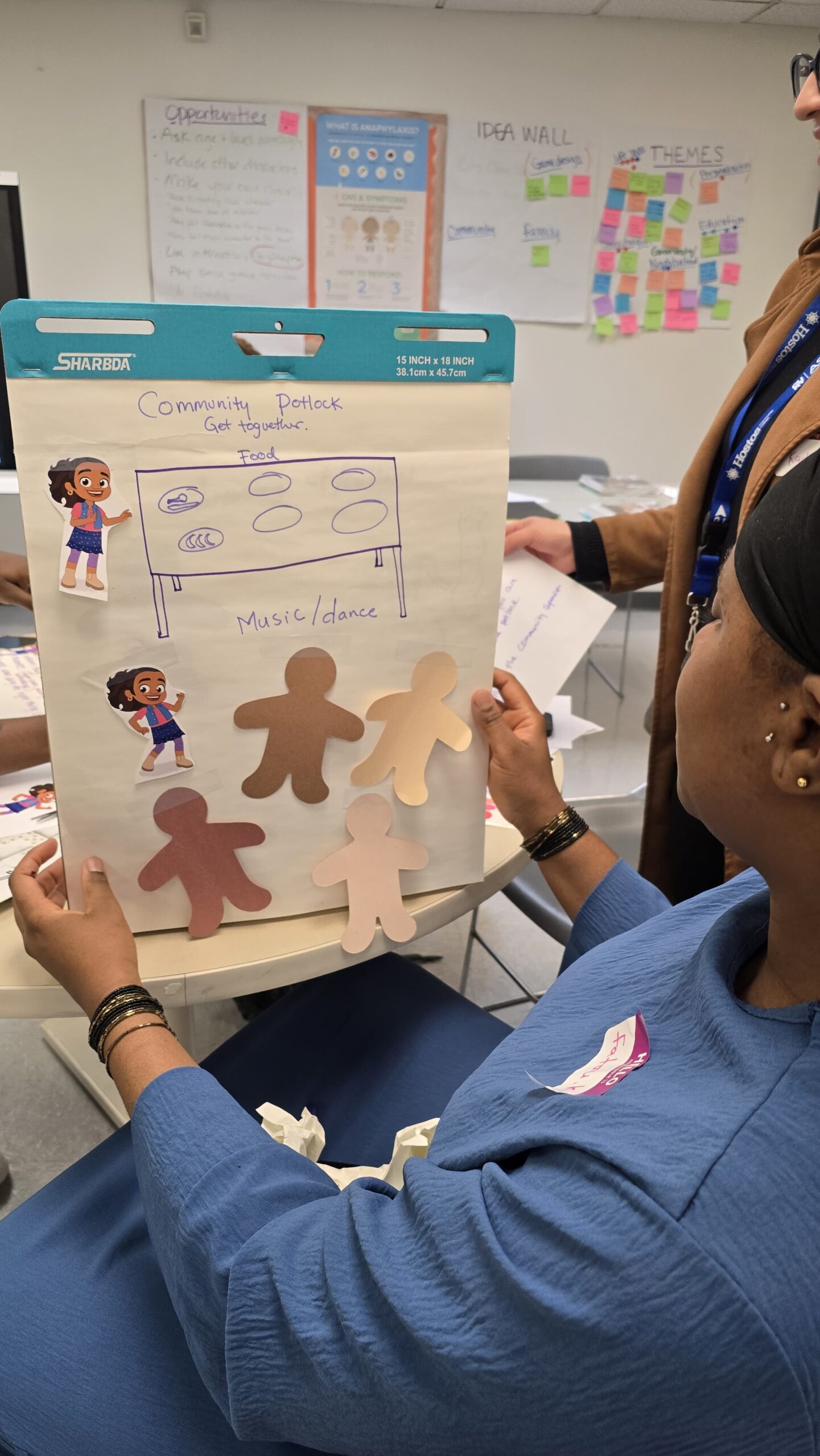
During one of our co-design sessions at the Hostos Children’s Center, a Bronx mother taped her game sketch to the wall and said, half laughing, half serious: “Nobody ever asked us to make a game before. But we know our kids better than anyone.”
That moment has stayed with me.
It captured something I had been thinking about since participating in the Well-being by Design fellowship: what happens when we stop treating families as respondents and begin treating them as design partners?
Alma in the Bronx emerged directly from that question. When I joined CUNY’s Hostos Community College as faculty last spring, I immediately saw an opportunity to connect my academic work with Alma’s Way, given its setting in the Bronx and its resonance with the community I was now part of. With that in mind, I developed Alma in the Bronx as my first funded research project at Hostos. The project unfolded in two phases with Bronx caregivers of preschool-aged children. In the first phase, we explored how families perceive Alma’s Way: what resonates, what feels authentic, and what could evolve. In the second phase, we shifted from conversation to construction. Caregivers worked in small groups to create original digital game concepts inspired by the series and grounded in Bronx life.
But the deeper influence of the fellowship was not in the format of the sessions. It was in the lens.
From Representation to Well-being
Before the fellowship, I might have framed this work primarily around representation: Do families feel seen? Do cultural elements resonate?
Through Well-being by Design, I began asking different questions.
- How does a digital experience support children’s sense of competence?
- How does it foster social connection?
- Does it create space for emotional regulation?
- Does it empower children to make meaningful choices?
- Does it feel inclusive in ways that are natural rather than performative?
These questions are closely aligned with the RITEC framework, which understands children’s wellbeing in digital spaces as multidimensional and encompassing competence, creativity, emotional regulation, social connection, inclusion, empowerment, and safety. Rather than treating culture as an add-on, this lens invites us to consider how design decisions shape children’s lived experiences.
In the first phase of Alma in the Bronx, caregivers described the series as warm, vibrant, and reflective of family closeness. They repeatedly said, “It feels like us.” They valued the bilingual dialogue, the intergenerational dynamics, and Alma’s reflective problem-solving.
At the same time, they wanted more texture. Several parents described the Bronx on screen as slightly “too sparkly.” They encouraged more environmental realism: smaller apartments, louder streets, more density, more humor with edge.
They were not evaluating whether culture was present. They were evaluating whether it felt lived-in.
Co-Design as Well-being Practice
The second phase of the project was directly shaped by insights I encountered during the fellowship, including Dr. Susana Beltrán-Grimm’s asset-based co-design framework. Her emphasis on families as interpretive and creative authorities influenced how the workshops were structured.
We began with playful warm-ups to signal that there were no wrong answers. Caregivers generated ideas on sticky notes, then clustered and named their own thematic categories—life skills, safety, culture, language, celebration. The categories were not imposed. They emerged organically.
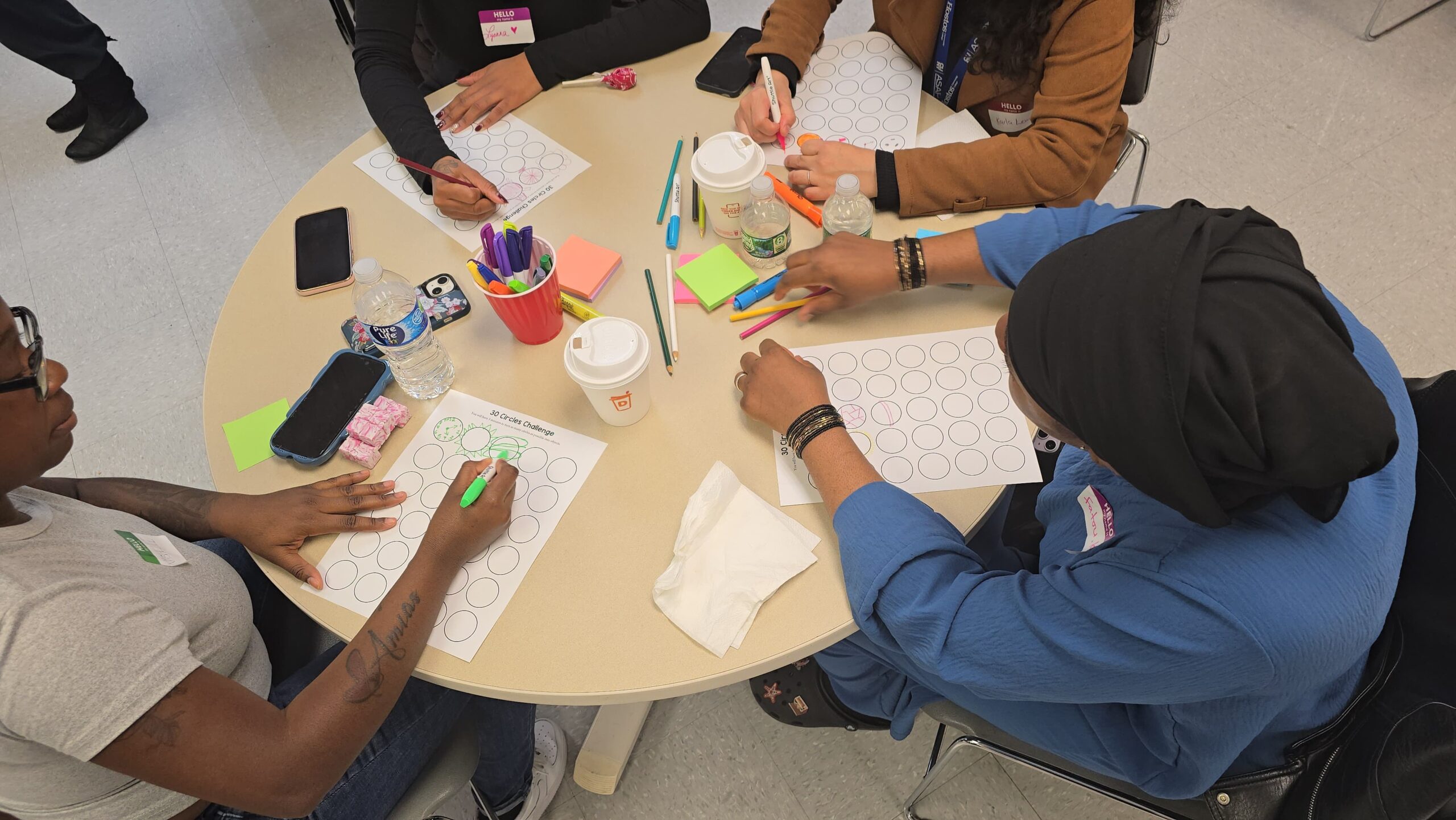
Then something shifted.
Parents who had just been analyzing the show began building games.
Across six independently developed concepts, remarkable convergence appeared. Caregivers created games centered on grocery shopping at C-Town, navigating busy sidewalks, morning routines in small apartments, park basketball, community potlucks, and visiting relatives abroad. They embedded learning inside everyday routines.
Math lived in grocery lists.
Executive function lived in getting ready for school.
Social-emotional learning lived in taking turns on the basketball court.
Civic awareness lived in crossing the street safely.
Bilingual switching was imagined as fluid and situational, not as a toggle feature, but as the natural soundtrack of home life. Inclusion was treated as environmental fact, not instructional moment. Co-play features were strongly valued, as parents wanted ways to see how their children think while playing.
In other words, caregivers instinctively prioritized many of the same well-being dimensions articulated in RITEC – competence, social connection, empowerment, and inclusion, without using that language explicitly.
The framework helped me recognize what was happening.
Fellowship as Bridge
Another powerful influence of the Well-being by Design fellowship was relational.
Rubin Soodak, a colleague at Fred Rogers Productions and fellow Well-being by Design alum, and I discussed the project in advance, knowing he would soon begin ideating the next batch of Alma digital games. That alignment was intentional. The co-design sessions were timed so caregiver insights could enter the process at the ideation stage, and not after decisions had already been made. He has since returned to extend the work with the community into the development phase.
Instead of positioning research and production as separate worlds, we were able to ask together: How do these caregiver insights translate into mechanics? How does tone live inside interaction? How does bilingual belonging become environmental rather than decorative?
When parents emphasized turn-taking and cooperation in their basketball game, Rubin noted how closely that aligned with existing Alma digital mechanics. When they described bilingual fluidity as atmosphere, it reframed how language integration might function in interactive spaces.
The conversation did not feel extractive. It felt iterative.
That alignment between community insight and production thinking was not accidental. It was seeded in a fellowship space that encouraged cross-role dialogue around children’s wellbeing.
Looking Forward: Responsible Design in Practice
As Alma in the Bronx evolves, I find myself returning to the RITEC framework not as an abstract guideline but as a practical tool. It prompts questions that feel grounded in what caregivers already articulated:
Does this mechanic build competence without overwhelming?
Does it support social connection, including intergenerational play?
Does it offer meaningful agency?
Does it reflect diverse children’s realities in organic ways?
RITEC reminds us that designing for children’s wellbeing is not only ethically sound, but it leads to stronger, more trusted digital products. Families are increasingly attuned to whether platforms respect children’s safety and growth. Studios that prioritize wellbeing can differentiate themselves while raising industry standards.
But what Alma in the Bronx suggests is that one powerful way to operationalize responsible innovation is through structured, community-rooted co-design. When families are invited into thoughtful, respectful design processes, they surface principles that align naturally with global wellbeing frameworks.
They may not use the vocabulary of “competence” or “empowerment.”
But they design for it.
From Fellowship to Field
Fellowship spaces matter not because they produce immediate deliverables, but because they shape how we see our work. They build shared language. They foster cross-sector trust. They plant seeds.
In my case, the Wellbeing by Design fellowship influenced the questions I asked, the structure of my research, the way I collaborated with production partners, and the frameworks I now use to guide responsible digital translation.
That mother’s comment, “Nobody ever asked us to make a game before,” captures the heart of it.
When families are invited into design conversations, children’s wellbeing moves from aspiration to practice. And that shift, from theory to lived experience, is where responsible innovation truly begins.

Dr. Mariana Diaz-Wionczek is an Assistant Professor of Psychology at Hostos Community College, CUNY, where she studies child development and the role of media and technology in learning. Before entering academia, she served as Head of Education and Research for Dora the Explorer and has advised organizations including PBS Kids and Sesame Workshop on research-informed children’s media. She is currently the Executive Producer of the Emmy-nominated series Rosie’s Rules, where she helps shape stories that foster children’s cognitive, social-emotional, and cultural development. Her work bridges academia and the media industry to create media experiences that authentically reflect children’s lives and support how they learn.