The Potential Uses of Television in Preschool Education introduced a new way of working: researchers, educators, writers, producers, and children came together to shape what to teach, how to teach it, and how to know whether it worked. Sixty years later, we revisit this seminal report with a new weekly series, The Blueprint Outlasted the Medium: The Potential Uses of Television in Preschool Education, Sixty Years Later.
This week, our contributors return to that model and the enduring idea that the best children’s media is built through cross-disciplinary collaboration, grounded in research, and shaped by children themselves.
I am watching my three-year-old son stare up at a daunting tangle of playground bars, unsure of whether he’ll be able to make the climb. But like many preschoolers, his first thought isn’t I shouldn’t do this. His first thought is I should try.
On the 60th anniversary of Joan Ganz Cooney’s legendary The Potential Uses of Television in Preschool Education, I am struck by how the report’s bold recommendations follow a similar philosophy to that of the preschoolers she set out to educate. She wrote:
“We should look upon the first year of broadcasting for preschoolers in the nature of an inquiry. There is no substitute for trying it, and evaluating its effects, if we wish to know whether or not television can be a valuable tool for promoting intellectual and cultural growth in our preschool population.”
Experimentation, innovation, and exploration were core to her recommendations, and they remain an indelible part of Sesame Street. Mrs. Cooney’s report is the blueprint that has ensured the series stays relevant and continues to educate new generations of children decades later.
But 60 years on, we face a watershed moment when experimentation can carry enormous risk. As children’s education, media, and technology change at lightning speed, there are more ways to reach children than ever, and more ways to get it wrong. Many are understandably averse to taking chances on anything that might not have broad appeal and adoption. But as Mrs. Cooney wrote years ago, “…the series must have maximum freedom to experiment with talent and ideas, if the potential of the medium to educate and stimulate young children is to be fully explored.” As researchers, developers, and practitioners, it is our duty to press on through today’s uncertainty and stay true to this message. To fully explore all the ways we can reach and educate young children, we cannot stop rethinking, reconsidering, and reevaluating our established approaches. As preschoolers’ worlds keep changing, so must we.
In our work to figure out how to best serve children and their families, we are never finished. Each passing year, we greet a new audience of children to whom we owe our very best. We must keep experimenting and innovating so we can reach and teach them with every tool we have, and build new ones as we go. Mrs. Cooney’s monumental report remains a blueprint for what is possible when we commit ourselves to this mission. And as I watch my son, intrepid as ever, scramble up the playground bars, I’m reminded why it matters so much.
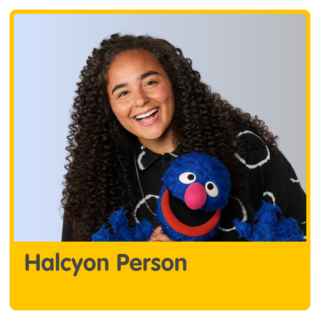
Halcyon Person is an Emmy, Humanitas, and NAACP Award-nominated TV maker who’s worked as a writer, director, and producer for everything from preschool to late night. She is currently the Head Writer and Co-Executive Producer of Sesame Street.