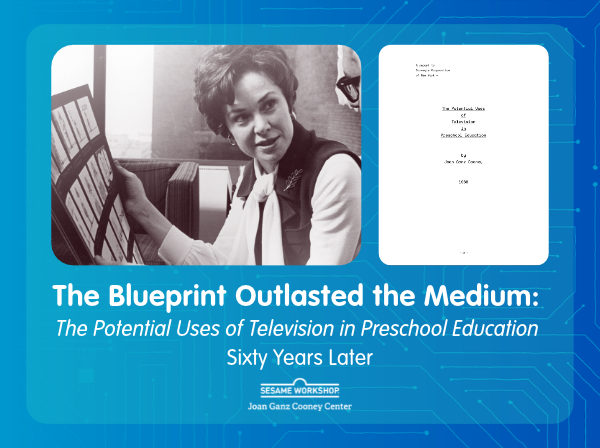
In 1966, Joan Ganz Cooney, then a documentary producer at New York City’s public educational television station Channel 13, hosted a small dinner party. Among the guests was Lloyd Morrisett, a family friend and vice president at the Carnegie Corporation of New York. Their conversation turned to the mesmerizing effects television had on young children—something Morrisett and his wife had witnessed with their own daughter, who would turn on the television and watch test patterns while waiting for cartoons to begin. Dr. Morrisett wondered aloud: Could television be a teacher to these young children?
That question set in motion a radical experiment in children’s media.
Soon afterward, the Carnegie Corporation commissioned Mrs. Cooney to explore how television might be designed to help young children learn. She spent four months consulting researchers and practitioners in child development, education, and television production, ultimately making the case for a new kind of children’s program: one that could educate through entertainment while bringing together people who understood children and learning with those who understood how to capture their attention and imagination.
Her report, The Potential Uses of Television in Preschool Education, became the founding document for Sesame Street and the Children’s Television Workshop (CTW), now Sesame Workshop. The collaborative approach it described is now known as the Sesame model.

Forty years later, the Joan Ganz Cooney Center was established as an independent nonprofit within Sesame Workshop to continue asking a modern extension of Mrs. Cooney and Dr. Morrisett’s original question: How can we use emerging media to help children learn?
Today, sixty years after that first experiment, the question feels more urgent than ever. Television is no longer at the center of children’s media. Children move fluidly among games, apps, social platforms, virtual worlds, and increasingly, artificial intelligence—often in environments that are evolving faster than our research, policies, and design practices can keep pace. At the same time, families and educators are grappling with fundamental questions about what children should encounter online, what role technology should play in their lives, and how we can ensure that the systems built for them support not just learning, but their well-being and ability to thrive.
In this rapidly changing landscape, it is worth looking back—with purpose, not only with nostalgia. What can the method that helped make Sesame Street possible teach us about creating children’s media today?
To answer this question, we have invited more than 40 leading voices in children’s media and technology—including producers, researchers, designers, and other innovators—to reflect on the enduring influence of the Sesame model and consider what it might offer the next generation.
Their perspectives arrive at a pivotal moment. Technology will continue to change, and so will the ways children encounter, create, and learn through media. But the principles behind this radical experiment—grounding innovation in a deep understanding of children, bringing disciplines together, and designing with both purpose and imagination—remain durable.
Over the coming weeks, we’ll share their reflections on what those principles mean for children’s media now, and where they might take us next.
Read the original report here.
Former Sesame Workshop President & CEO Jeffrey D. Dunn reflects on The Potential Uses of Television in Preschool Education and points to its enduring impact on the landscape of children’s educational media.
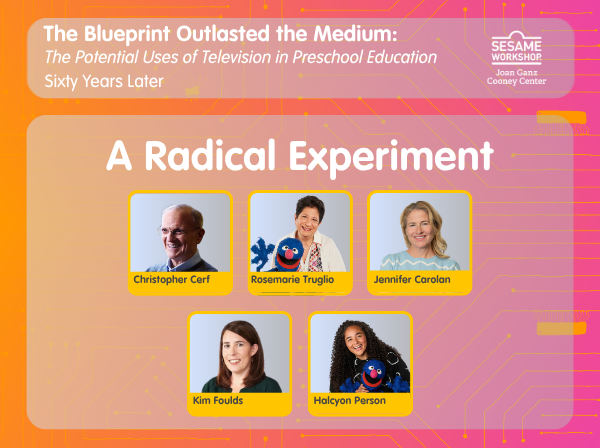
The Potential Uses of Television in Preschool Education introduced a new way of working: researchers, educators, writers, producers, and children came together to shape what to teach, how to teach it, and how to know whether it worked. Sixty years later, our contributors return to that model and to the enduring idea that the best children’s media is built through collaboration across disciplines, grounded in research, and shaped by children themselves. These five essays explore why that approach remains such a powerful place to begin.
Christopher Cerf: An Arranged Marriage, Reimagined
Rosemarie Truglio, PhD: What Is It Teaching?
Jennifer Carolan: The Best Edtech Business Plan You’ve Never Read
Kim Foulds, PhD: The Hypothesis Endures
Halcyon Person: There Is No Substitute for Trying It