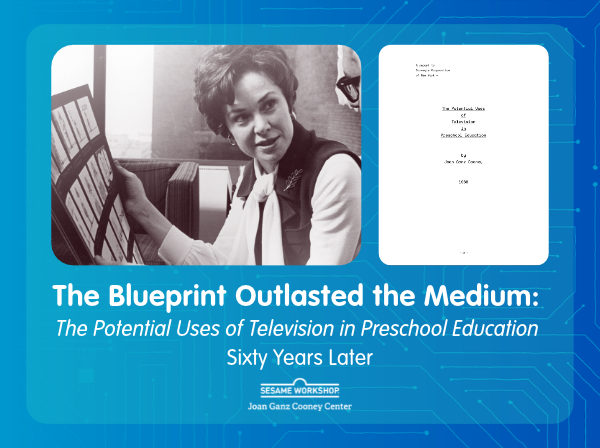
The Potential Uses of Television in Preschool Education introduced a new way of working: researchers, educators, writers, producers, and children came together to shape what to teach, how to teach it, and how to know whether it worked. Sixty years later, we revisit this seminal report with a new weekly series, The Blueprint Outlasted the Medium: The Potential Uses of Television in Preschool Education, Sixty Years Later.
This week, our contributors return to that model and the enduring idea that the best children’s media is built through cross-disciplinary collaboration, grounded in research, and shaped by children themselves.
In 1966, Joan Ganz Cooney asked a question no one had tested before: Could the power of television, already capturing children’s attention, be used to teach preschoolers school-readiness skills?
The 1970 and 1971 impact studies of Sesame Street answered with a resounding yes. That answer has held for nearly 60 years across more than a thousand studies in the United States and around the world. But the finding was never simply that television can teach. It was that television can teach specific lessons when it is intentionally designed to do so.
What made Mrs. Cooney’s answer endure was not the medium itself, but the model she built around it: the Children’s Television Workshop Model, now known as the Sesame Workshop Model. Every part of the model served intentional learning.
- Curriculum goals came first.
- Research with children, whom Joan called the real experts, tested both engagement and comprehension.
- Writers and producers used humor, playfulness, and craft to advance those goals.
- A diverse, inclusive on-screen community of puppets and humans helped children see themselves and invited families into the experience.
Continuous experimentation kept the model accountable, allowing production and curriculum to evolve with children’s needs. As technology changed, the model endured because it remained focused on relevance, engagement, and children’s academic, social, emotional, and health needs.
Sixty years later, key components of that model now face mirror-image opposing forces. Joan began with curriculum goals before production; today’s dominant model often begins with engagement metrics, especially watch time. She used research to confirm that children learned the intended concepts; platforms competing for viewership typically measure retention, not comprehension.
Her production teams worked within a curricular focus. Today, production techniques are often designed to override a child’s instinct to look away, without assessing whether the child has learned anything meaningful. The model is not gone; many children’s producers still use it. But it now competes with a media environment engineered, with equal deliberateness, toward the opposite end.
In 1966, Mrs. Cooney gave real meaning to “intentional educational television for preschoolers.” We need that clarity again. Too much content now calls itself educational, without naming a learning goal or demonstrating what children actually learn.
Today, one of her most important insights is too often overlooked: all media teaches, but the essential question is, “What is it teaching?” At a time when more content than ever claims to educate young children, we cannot let “educational” become an empty label.
Joan Ganz Cooney’s original vision should remain the standard: use media thoughtfully; consider each child’s needs and temperament when choosing media; and attend not only to what children watch, but to what they take away from it. Then, use those screen-based lessons to encourage real-world, hands-on experiences that deepen curiosity, strengthen connection, and nurture the joy of learning.
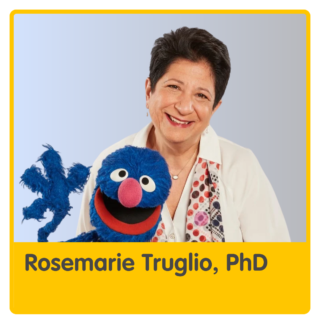
Rosemarie T. Truglio, Ph.D. is the Senior Vice President of Global Education at Sesame Workshop. Dr. Truglio is responsible for the development of the interdisciplinary curriculum on which Sesame Street is based and oversees content development across platforms (e.g., television, digital media, publishing, toys, and theme park activities).