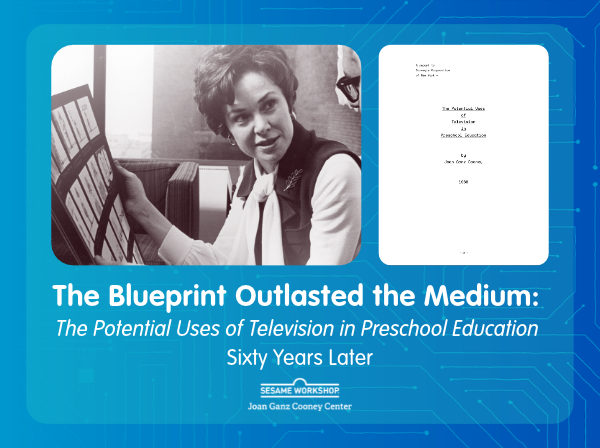
Sixty years ago, Joan Ganz Cooney asked whether television could do more than capture children’s attention—could it help them learn how to think? That idea became a hallmark of Sesame Street, where children were invited to sing along, answer back, and go make things. Today, children are not just watching media; they’re creating, designing, and shaping it.
This week, our contributors explore what it means to move from making media for children to making it with them—and why engagement and learning are not the same.

In 1966, Joan Ganz Cooney’s method was to look closely at what children were already doing while adults dismissed it as noise. She found kids shouting for Batman, memorizing jingles, and picking up vocabulary from programs that were not labeled educational – gasp. Then she asked what those programs were doing right. For me, the question is less which emerging medium she would prioritize today than which behavior she would take seriously before the rest of us did.
I think she would notice that children are no longer merely audiences. They are authors, creators, and entrepreneurs. On Roblox, children are building, scripting, and participating in an economy. Her 1966 report argues for the child to be active rather than passive, and ends with the hope that children will switch off the set and go make something. That wish is now being realized inside the medium rather than outside it. A different kind of activity than she imagined, but activity all the same.
It is also worth saying that the same durability and public visibility that make a child’s creation meaningful are exactly what keep parents up at night. The opportunity and the worry are the same feature. The design problem Joan Ganz COoney left us is no longer how to encourage children to create, but what to do when nearly everything they create online is social, public, and durable.
I would hope Mrs. Cooney would also look hard at generative AI. I suspect she would ask the same question she asked about commercials: What is this doing well, mechanically, that educators and other adults struggle to do? One honest answer is patience. A model will answer the fifth “why” in the same tone as the first. That is a real pedagogical property, and a real reason to worry about whom a child prefers to ask.
Finally, I believe she would look at parental support and ask why we dropped the piece she had already budgeted for: a weekly half hour for parents, which several of the educators she interviewed considered more important than the children’s program itself. Parents need to stay interested today, just as they did 60 years ago. Joan Ganz Cooney understood that adults must remain curious about what children are doing. Today, that means not simply monitoring their activity, but trying to understand it.
Dr. Elizabeth Milovidov is a lawyer, law professor, a leading expert in child online protection, and the founder of DigitalParentingCoach.com. She currently serves as Senior Director, Global Head of Parental Advocacy at Roblox, where she empowers families to navigate the digital world safely.