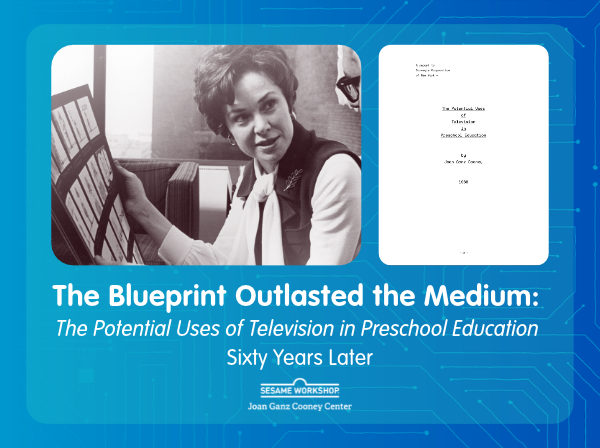
In the 1960s, FCC Commissioner Newton Minow famously called the television landscape “a vast wasteland.” With the rise of algorithmically driven video feeds, AI-generated content, and an endless stream of choices, how does today’s media landscape compare? Our contributors consider what it means to pursue quality in an environment shaped by commercial incentives and powerful new technologies—and why retreating from technology isn’t enough.

Sixty years ago, pioneers like Joan Ganz Cooney dreamed of tapping the power of emerging technologies to enrich children’s learning. Stanford philosopher Patrick Suppes predicted that within a few years, children would have access to the personal services of a tutor as well-informed and responsive as Aristotle. In 1967, Alan Kay designed the “Dynabook,” a prototype for children that contained many of the core elements found in today’s iPad, Chromebook, or Android tablet.
In 2010, when the first iPad came to market, I asked The Learning Company co-founder Ann McCormick about its significance for children. “The iPad is the computer we always dreamed of in the 1970’s,” she said. Unlike the Apple II—which required a dedicated desk, floppy disks, and a tangle of power cables—the iPad was portable, featured a beautiful touch screen, and offered instant access to thousands of affordable, high-quality educational apps. The potential of this technology to “make goodness attractive,” in the timeless words of Fred Rogers, was staggering.
Yet, somewhere along the way, this vision derailed. Today, the majority of children are not watching quality educational videos or playing with developmentally appropriate apps. Instead, a profit-driven media culture rewards viral popularity over substantive quality, opening the floodgates to “free” content designed as psychological sand traps. A curious child navigating YouTube is often only a few taps away from low-quality, AI-generated content. This issue disproportionately affects families on limited incomes who must skimp on paid applications or monthly subscription fees. Instead of enriching children’s lives, this powerful technology degrades it. If the true test of a society’s morality is what it does for its children, as Dietrich Bonhoeffer suggested, then the United States and many developing countries are currently flunking.
To fix this, we must remember that the inspiring, foundational potential envisioned by Cooney, Suppes, Kay, McCormick, and others has not been uninvented—it has simply been diluted. It is entirely possible to envision a world where trusted, well-funded, and research-backed children’s media is universally available so that every child can become smarter, stronger, and kinder; as Joan Ganz Cooney intended.
Failing to use technology for this purpose is fundamentally wrong. Imagine a medical doctor who possesses a life-saving technique but stays silent, letting the patient suffer; our current approach to children’s media operates under a similar negligence. It is time for the modern gatekeepers of children’s media—including Apple, Google/YouTube, Netflix, Meta, TikTok, and Amazon—to step up to their universal and moral responsibility to protect and nurture young minds.
They should take their cue from Fred Rogers, who famously noted that “the space between the television set and the viewer is holy ground.”
Until these mega-corporations willingly accept this mantle, they must be regulated by lawmakers who understand that manipulating a child for profit is akin to stealing candy from a baby. A country that can afford a powerful military can certainly afford a public media system that supports independent, commercial-free, high-quality content for its children.
In 1967, when Lyndon Johnson signed the bill for the Corporation for Public Broadcasting, he said “today our problem is not making miracles—but managing miracles.” It’s 2026. It’s time to start managing.
Warren Buckleitner is an educational researcher and product reviewer with a specialty in the design of children’s digital media. He’s currently a Clinical Specialist at The College of New Jersey where he teaches design and creative technology; including a class on the Methods of Fred Rogers. He covered children’s technology for the New York Times for over a decade. He and his little sister used to love watching Sesame Street in the early ‘70s.
REFERENCES
Bonhoeffer, D. (1997). Letters and papers from prison (E. Bethge, Ed.). Touchstone. (Original work published 1943).
Johnson, L. B. (1967, November 7). Remarks upon signing the Public Broadcasting Act of 1967. Lyndon Baines Johnson Library and Museum. lbjlibrary.org object/text/remarks-upon-signing-the-public-broadcasting-act-of-1967
Kay, A. (1972). A personal computer for children of all ages. Xerox Palo Alto Research Center.
Suppes, P. (1966). The uses of computers in education. Scientific American, 215(3), 206–221. scientificamerican.com