How edtech partners in the Sandbox keep research at the center of product development
On a warm spring afternoon, an elementary school classroom in Manhattan became a laboratory for an emerging variety of edtech—the kind without screens.
The flattop desks were pushed together to create workstations stocked with multicolored pipe cleaners, markers, construction paper, kid-safe scissors, tape, and googly eyes. The designers included half a dozen kids in kindergarten and first grade working with researchers and product developers from the edtech startup, Cali’s Books.
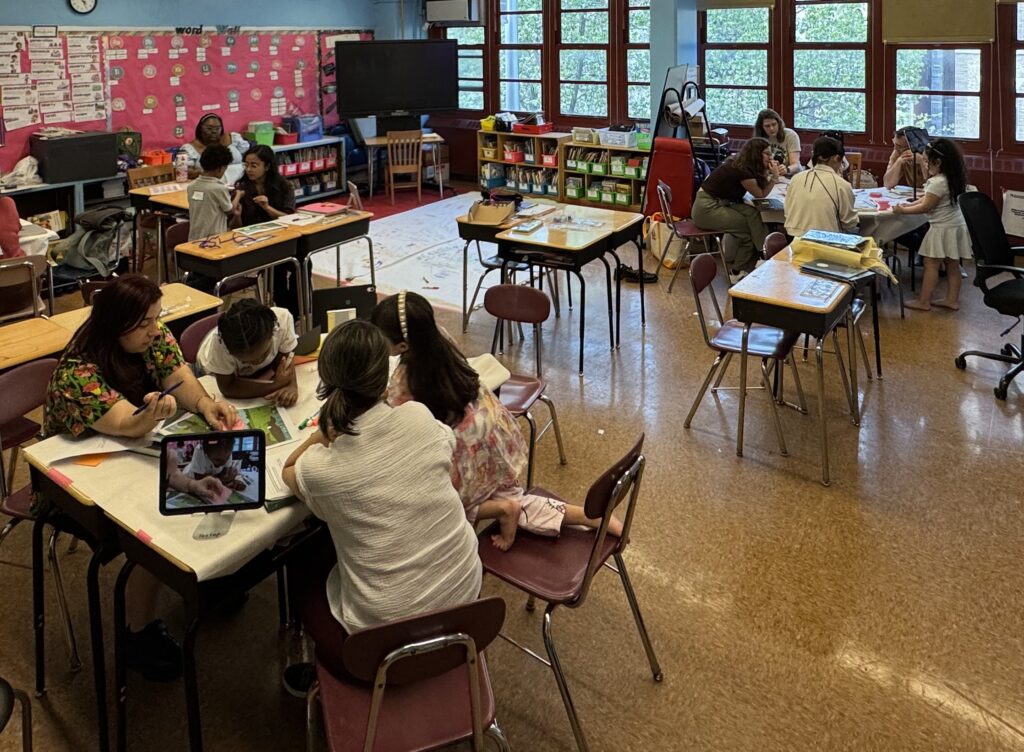
The company’s latest product is the Infinibook, a slim digital reader with the look and feel of a book cover that connects wirelessly to specially designed paper storybooks placed inside it and augments the stories with interactive elements such as audio narration, sound effects, and leveled questions about the story. The challenge for the co-design session was to brainstorm new interactive features for the Infinibook that would deepen reading comprehension without distraction.
“We want to use technology to drive engagement and help young readers, without taking them away from the purpose of reading the book itself,” said Michael Pursey, chief technology officer at Cali’s Books and one of the afternoon’s co-designers.
Screen-free edtech occupies a small but growing place in the educational landscape where technology’s promise of more personalized and engaged learning intersects with the risk of oversaturating kids with devices. Cali’s Books is one of two current partners in the Cooney Center’s Sandbox for Literacy Innovations operating in this nexus. The other is Creative Media & Research, a startup developing a digital, audio-only cooperative game for kids and their caregivers (the product’s name has not yet been announced). With the help of the literacy and co-design experts in the Sandbox, both companies are pushing the boundaries of what edtech can do beyond the screen.
Tech That Connects
The founder of Cali’s Books, Carinne Meryignac, wanted her kids to share the joy and enthusiasm she felt for reading, a love rooted in paper books that drew you deeper into a story as you flipped one page to the next (or a caregiver did on your behalf). She started brainstorming ideas for tech-augmented paper books after her young children started kindergarten and were promptly put in front of Chromebooks for classroom learning.
“I’m an engineer by training, and so I really believe in technology. I even believe in using a screen at some points in education,” she said. “But being a mother and seeing the effects of this technology on little kids, it was very clear that this technology was not designed for them.”
Meryignac’s reaction to Chromebooks in kindergarten reflects a broader concern over how soon and how much learning should be done via screens. While the shifting “screen time” debate has simmered for decades, it gained new impetus in the wake of the Covid pandemic. During the months of school closures, learning via devices became a necessity. The protracted crisis accelerated a longstanding movement toward screen-based learning, and the subsequent revolution in artificial intelligence supercharged it. Meanwhile, however, more studies started linking chronic device use in and out of the classroom to reduced knowledge retention, more distraction, and even altered sleep, which can impact brain development.
Given this pushback, many states, districts, and schools are taking steps such as banning smartphones, curtailing in-class device use, and introducing tech-free “brain breaks” for kids. In a recent New York Times story about this trend, Richard Culatta, CEO of the edtech nonprofit ISTE+ASCD, said schools should “rebalance” their use of technology, rather than banish it entirely.
“We do have to be careful,” he said, “that we don’t actually end up harming kids by taking away tools that are really helpful for them for their future.”
Plus, these tools are often incredibly useful for students with disabilities and for distance learning. Indeed, perhaps ironically, the screen-free edtech that Creative Media & Research is refining in the Sandbox was sparked by video conferences during Covid. The company’s founder, Christine Ricci, and her co-creator Katherine Papazian had worked together for years developing children’s media, which included talking with young kids about stories, characters, and related activities. The pandemic forced these conversations to go virtual and to include parents and other caregivers alongside the children.
“The most interesting part for us was how many parents weren’t aware of how verbal their kids were,” said Ricci. After these chatty sessions with their kids, Ricci recalled parents exclaiming, “Wow, we had no idea they had so much to say.”
Studies find that children whose parents engage them in more conversation develop better language skills, vocabulary, verbal reasoning and other building blocks of literacy and overall neural development. Ricci and Papazian sensed a “crisis of conversation” in families where bedtime reading was on the wane and digital devices were increasingly luring people of all ages away from in-person interactions.
Their solution is a cooperative game for preschoolers to play with caregivers, which will run on mobile devices but as an audio-only experience, guided by a host voice prompting listeners to share stories, songs, and jokes related to recent shared experiences such as running errands, getting groceries, or making dinner.
“We wanted to find a way to harness those everyday moments when parents and kids tend to be together,” said Ricci, “to help foster conversations between parents and kids.”
Above All, Be Intentional
From a design perspective, ditching screens has both pluses and minuses for edtech creators. For instance, Papazian said, their product’s lack of visuals reinforces their product’s focus on shared experiences between child and caregiver.
“Audio-only allows us to create something that feels more personalized in a way, because we aren’t showing them preformed visuals that aren’t relevant to them,” she said. “We allow them to create their own mental movies from their own experiences. And that allows them to strengthen their creative thinking and problem solving.”
In the Sandbox, they’ve tried to enhance this effect by changing the host’s approach from something quiz-like—asking parents and kids questions in turn—to prompting parents and kids to keep building on what the other just said.
At the same time, Papazian noted that audio-only humor can be “pretty challenging for this age group.” In addition, the lack of visuals complicates efforts to cue children and adults to start, or stop, talking between the host’s prompts. A screen could feature a big timer or a light that turned on or changed color for this purpose. Ricci and Papazian would need to do it all with sound. At a recent co-design session, they tried varying the length of pauses after a host’s prompt, and they tested subtle and no-so-subtle hints for speakers to wrap it up.
“We were playing with different approaches,” Ricci said. “Should a clock start ticking near the end, and beep when times up? Should we start playing music that ramps up in volume, to drown you out, like an awards-show playoff?”
In a broader sense, the built-in constraints of screen-free edtech may help ensure that every interactive feature is added with intention, minimizing extras that developers of screen-based edtech might include just for fun or to dial user engagement up to eleven.
For instance, a 2026 meta-analysis of screen-based digital books found that designers often loaded up the stories with features “intended to captivate children’s attention through interactivity and entertainment—often at the expense of narrative cohesion.”
The analysis found that mini-games, which interrupt stories with little puzzles, drawing, or similar activities, tended to distract and disrupt young readers, while their comprehension was deepened by “mimicking actions” such as asking the child to press a dashboard button that the protagonist also pressed in the story without knowing what would happen.
One co-author of the analysis was Natalia Kucirkova, director of the International Centre for EdTech Impact, a professor of reading and early childhood development at the University of Stavanger in Norway, and a member of the Cooney Center’s advisory board. Kucirkova noted optimistically that more recent digital books (created after 2019) have shifted toward more meaningful, narrative-driven interactions that draw young readers deeper into a story.
“I would hope that what we’re seeing reflects a growing awareness among edtech developers that it’s not about simply adding features because they are technically possible,” she explained, “but to be more intentional about what actually serves children’s learning.”
According to Ricci, an intentional ethos drives the edtech development at Creative Media & Research. “Everything we do is related to enhancing that shared engagement between parents and children by conversing about a shared memory. We want to keep the focus on each other, not on the device,” she explained.
Likewise, before the kids arrived to unleash their unbounded creativity at the co-design session for Cali’s Books, Angelica DaSilva, a Cooney Center fellow for literacy and technology, reminded her fellow co-designers to keep proposed mid-story activities brief and focused on the characters and plot.
“I start to cringe a little whenever I hear ideas for adding lots of creativity into the middle of a story,” DaSilva said. “You don’t want to draw attention away from the flow of the story, especially for little kids.”
Afterward, Pursey of Cali’s Books noted that the kids he worked with wanted the option to turn off interactive elements and just follow the story. “If they wanted a game, it didn’t need to be that complicated, and they wanted a button they could push to start or stop these experiences,” he said. “It was very interesting to see how less is more in many ways.”