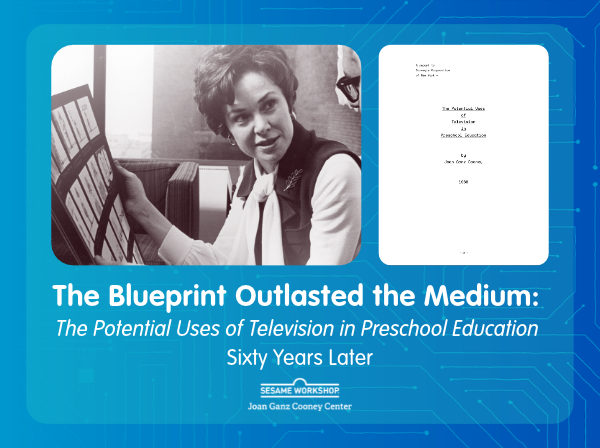
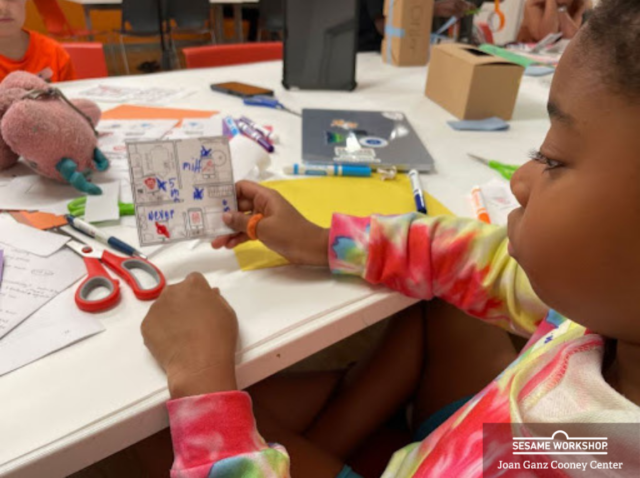
Sixty years ago, Joan Ganz Cooney asked whether television could do more than capture children’s attention—could it help them learn how to think? That idea became a hallmark of Sesame Street, where children were invited to sing along, answer back, and go make things. Today, children are not just watching media; they’re creating, designing, and shaping it.
This week, our contributors explore what it means to move from making media for children to making it with them—and why engagement and learning are not the same.

In 1966, television could ask a child a question, but it had no way of knowing whether the child answered back. Joan Ganz Cooney nevertheless wanted children to respond—to sing, clap, correct mistakes, make things, and think along with what they saw.
Today, our devices track nearly everything a child does. But as media have become more interactive, it has become easier to confuse activity with learning. For all that data, we may still not know what the child was thinking.
Joan Ganz Cooney’s 1966 report offers a useful way to sort through that confusion. Most of the educators she consulted wanted television to develop “cognitive habits” like analysis, generating hypotheses, and reflection, rather than simply offer facts. They wanted television to teach children “how to think, not what to think.” Mrs. Cooney herself wrote that one aim was to make children “more responsive—to be active rather than passive,” worrying that television left them relying “less and less on their own imagination and resources.”
One of her proposed games illustrates the difference. A child would see three ducks and a cat and be asked to touch the picture that was different. “After a few seconds,” the cat would light up, revealing the answer. She noted, almost in passing, that the game would encourage interaction between child and program. The pause was just as important as the puzzle, because that’s where the child got to think.
So what should count as “active” today, when a screen can react instantly to almost anything a child does? That responsiveness can give the child more to think about, but it should not take away the child’s opportunity to think.
What does the child have to figure out? Is there something for them to notice, predict, connect, or explain? Does selecting, speaking, or moving require judgment, memory, reasoning, or creativity? Does the design leave room to hesitate, make a mistake, try again, or keep working on a problem for at least a little while before offering help?
Her “fundamental question” was whether a television program could be enticing enough that children would want to watch while also accomplishing educational goals. Attention mattered then, as it does now—but as a means, not an end.
We now have technology that can suggest ideas, provide answers, complete sentences, or solve problems. The more the technology can do, the more important the pause becomes: the space where the thinking still belongs to the child.
Michael Preston, PhD, is the Executive Director of the Joan Ganz Cooney Center, an independent research and innovation lab at Sesame Workshop dedicated to ensuring that digital and AI-powered technologies serve children’s best interests.