In the 1960s, FCC Commissioner Newton Minow famously called the television landscape “a vast wasteland.” With the rise of algorithmically driven video feeds, AI-generated content, and an endless stream of choices, how does today’s media landscape compare? Our contributors consider what it means to pursue quality in an environment shaped by commercial incentives and powerful new technologies—and why retreating from technology isn’t enough.

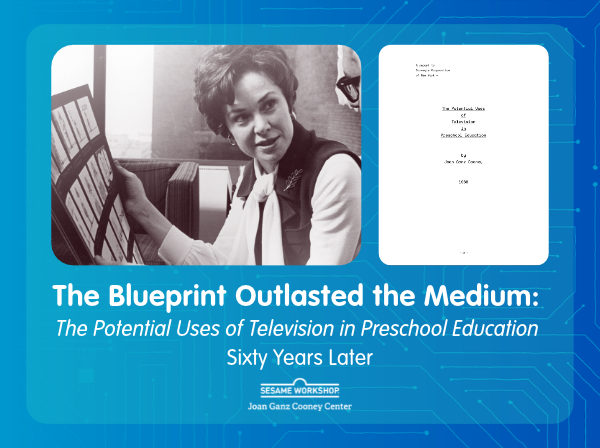
In 2020, the Joan Ganz Cooney Center invited me to revisit the Sesame Street creator’s seminal 1966 report, The Potential Uses of Television in Preschool Education. I found multiple aspects still relevant a half-century later. Presented with a similar request for the report’s 60th anniversary, I’m struck by similarities and differences in creating children’s media for 1960s scarcity and 2020s omni-media.
In 1966, television had only a handful of channels and very few schedule slots for children. Opportunities for new ideas were vanishingly small, so Sesame Street had little competition at its start. Segments were tested with distraction devices that assessed engagement by peripherally presenting still photos. This seems quaint in our current world of infinite options clamoring for children’s attention.
Cooney acknowledged that her vision was but one of many possible approaches to using TV for education: …it is well to remember that any group of creative people brought together to produce such a series would devise many, many more.
The white paper’s many references to children’s attraction to high-engagement alternative programs (e.g., Batman) suggest awareness that Sesame Street would have to compete in the marketplace, but could the Sesame team have imagined today’s always-on, on-demand, data-driven overwhelm?
Positively, one program no longer needs to serve all children; diverse families have options to suit their child’s specific developmental needs, abilities, and interests. Unfortunately, the paradox of choice turns content discovery into an ongoing game of whack-a-mole. Thoughtful, vetted, age-appropriate offerings sit level with AI slop, algorithmically engineered fare, plagiarized IP, and content designed to sell not tell.
That 1960s collective of visionaries who crafted Sesame Street under scarcity would now need to juggle a Rubik’s Cube of developmental insight, teaching intent, content alignment, device and platform fit, financial model, and more. Like the puzzle cube, altering one facet re-aligns all the others.
As I noted in 2020, Joan Ganz Cooney’s wisest choice was to label her efforts a “Workshop,” suggesting continual examination, evaluation, and evolution. We don’t have to wonder how today’s Sesame team would make wise use of emerging tools for creation and distribution, because the evidence is clear. Across social media shorts and messaging, apps, game worlds, and multi-platform delivery, Sesame Workshop maintains the original vision of child-centered, research-based engagement for learning.
David Kleeman has been a children’s media analyst, strategist, author, speaker, and connector for over 35 years. As a “Playvangelist,” he advocates for recognition that the context in which kids grow and learn changes, but the essentials of child development don’t.