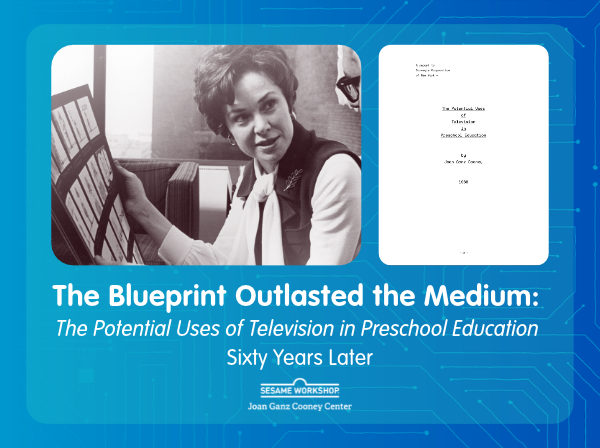
Joan Ganz Cooney understood that children’s media does not exist in isolation. Parents, caregivers, and teachers help children connect what happens on screen to the world around them. This week, our authors consider the role of the caring adult in a media landscape that is increasingly personalized, pervasive, and difficult to navigate—and how technology can support, rather than replace, human connection.

Joan Ganz Cooney’s 1966 report was an emphatic and unapologetic call to action, to embrace what became Sesame Street’s greatest lesson: that young children can learn more–much more–than grown-ups think, if given the right experiences. And that they can do so joyfully, with laughter and creativity, moving their bodies and exercising their minds, with media, families, and friends.
One of the most insightful, if forgotten, recommendations of her report was that two shows should be produced: one for the preschool children and one for their parents. She understood that parents are a child’s first and most important teachers and that the more parents knew about how to raise their children, the “smarter, stronger and kinder”, to quote Sesame Workshop’s motto, their children would be.
What would a Sesame Street for parents look like today? Answering that question, sixty years later, would still pay enormous benefits for our families and our society. More than a program, Sesame Parents could be a platform that presents a contemporary mix of compelling characters and entertaining segments while also enabling parents to practice their skills, share with others, and track their progress.
Re-reading Mrs. Cooney’s report, her keen intelligence shines through. It’s astonishing how much she assimilated about child development in a short three-month period. And how clearly and persuasively she marshaled the case for using television and its myriad techniques to teach our youngest children, which some experts dismissed as folly. One of my favorite sentences still rings true for media today: “It is an irony of television that, for all its potential to educate, it also provides endless distractions from pursuits of the mind.” Joan’s talents, evident through her words, would be given full expression in her courageous and innovative leadership of Sesame Workshop in the decades to come.
In 2026, we live in a world transformed by media and technology, but many of the same barriers to education, health, and prosperity persist. Now is an ideal time for a new report, “The Potential Uses of AI in Education, From Preschool Onward”. Can we imagine Sesame Street in the Age of AI, for children and parents? When that paper is written, its authors should acknowledge their shared intellectual DNA with Joan Ganz Cooney, who should be considered among the most important women of our time.
In his first job after college, Milton Chen served in Sesame Workshop’s research department from 1976-1980. He has also been an education director at KQED (San Francisco), executive director of The George Lucas Educational Foundation (edutopia.org), and a Trustee of Sesame Workshop (2010-2020). He is currently a trustee of the Kellogg Foundation in Michigan.