Joan Ganz Cooney understood that children’s media does not exist in isolation. Parents, caregivers, and teachers help children connect what happens on screen to the world around them. This week, our authors consider the role of the caring adult in a media landscape that is increasingly personalized, pervasive, and difficult to navigate—and how technology can support, rather than replace, human connection.

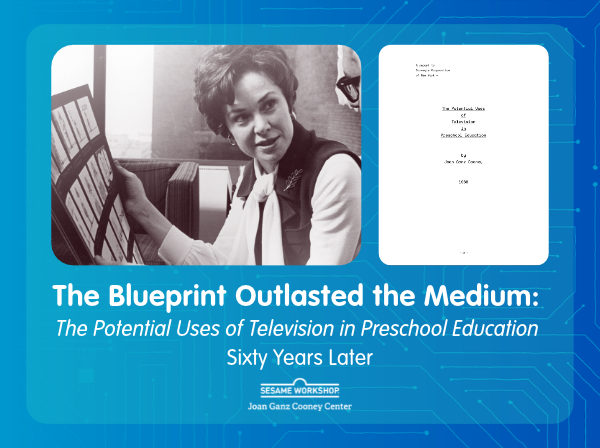
It is hard to believe it has been 60 years since Joan Ganz Cooney’s landmark report, which laid out a strong argument about young children’s learning. I remember reading this piece in graduate school several years later and recognizing how profound her insights were.
Several claims are now truisms about children’s development: the important role of engaging young preschool children with a learning environment that is fun, that parents and caregivers play an important role in helping young children focus on the media learning materials, and most important, that the medium of television can be a vehicle to teach children important school readiness lessons. Moreover with the launch of Sesame Street in 1969, we’ve learned that how media influence children’s development can be understood in terms of the nature of the child, the social context of media use, and the nature of the medium itself.
In the years since we’ve learned that each technology innovation (e.g. the internet, podcasts, social media) all have unique ways of engaging and educating children. And they also have potential limitations and concerns for parents and caregivers. Today’s public concern about artificial intelligence is an example which holds special concerns about young child users, most especially children’s abilities to distinguish bots from real people. Our approach to understanding this concern and finding ways to mitigate it owes much to Joan Ganz Cooney’s original insight that media, when produced with an understanding of the developmental characteristics of young children, can be powerful educational resources.
Ellen Wartella is the Al-thani Professor of Communication Emerita at Northwestern University and a scholar of the effects of technology on children’s health and development. She has served on the Sesame Workshop Board of Trustees and the Joan Ganz Cooney Center Board.