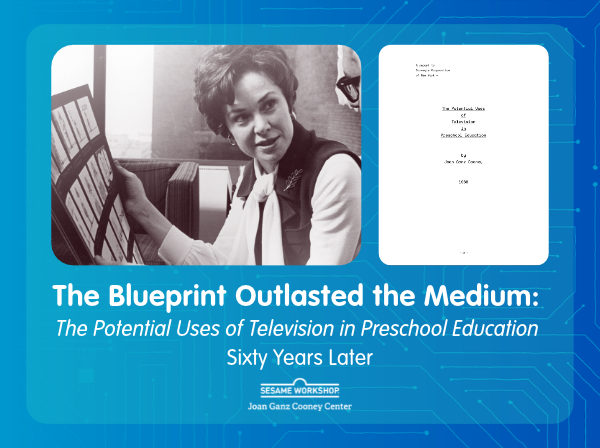
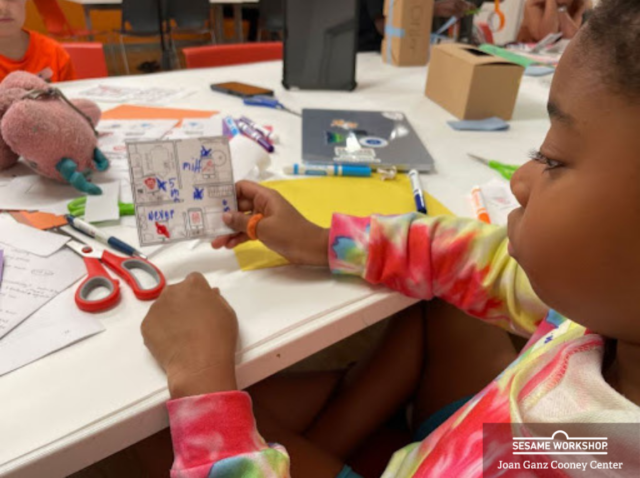
Sixty years ago, Joan Ganz Cooney asked whether television could do more than capture children’s attention—could it help them learn how to think? That idea became a hallmark of Sesame Street, where children were invited to sing along, answer back, and go make things. Today, children are not just watching media; they’re creating, designing, and shaping it.
This week, our contributors explore what it means to move from making media for children to making it with them—and why engagement and learning are not the same.How might co-design with children fit into a modern version of Joan Ganz Cooney’s message?

In my reading of the 1966 report, I found myself lingering on Section III: “What Leading Educators Think About a Television Series for Preschoolers.” In this section, Joan Ganz Cooney writes, “Nearly everyone with whom I met liked the idea of a daily, hour-long program designed to be viewed at home by three, four and five-year-olds.” The report includes an impressive list of famous names, among them Drs. Jerome Bruner and Carl Bereiter, both giants in cognitive psychology and the learning sciences.
While the original report has drawn both support and criticism from educators over the years, I’m curious what Mrs. Cooney would say today about children’s perspectives on developing educational media and technology. Since the 1990s, we’ve accumulated substantial evidence that children — even preschoolers1, 2 — can co-design technologies and media with adults in ways that support their own well-being.
We now know that, with the right setup, techniques, and methods, treating children as design partners3 can yield powerful insights for designers, researchers, policymakers, and educators — insights that matter most for kids themselves. Looking back at the educators Mrs. Cooney consulted, three points stand out to me as especially prescient: (1) children should be encouraged to be active participants in programming (singing, dancing, clapping, and so on); (2) children’s media can enlist the cooperation of community groups (schools, libraries, community programs); and (3) parents are essential to children’s success with children’s media and technology.
These remain crucial points. Co-design with children can add nuance to these points. How would children build out that active participation themselves? What do they see as meaningful involvement from community structures around digital media? And how do children want their parents involved in that experience?
Overall, I believe Joan Ganz Cooney’s vision for children’s media resonates as much today as it did in 1966. We still have a long way to go—but bringing children into the conversation as design partners can help take us further.
Jason Yip, Ph.D. is an associate professor of digital youth at The Information School at the University of Washington – Seattle. He is the director of KidsTeam UW (kidsteam.ischool.uw.edu), a co-design team of adults and children working together to make technologies and designs for children, with children.
1 Hiniker, A., Sobel, K., & Lee, B. (2017, May). Co-designing with preschoolers using fictional inquiry and comicboarding. In Proceedings of the 2017 CHI Conference on Human Factors in Computing Systems (pp. 5767–5772).
2 Hoareau, L., Tazouti, Y., Dinet, J., Thomas, A., Luxembourger, C., Hubert, B., … & Jarlégan, A. (2020). Co-designing a new educational tablet app for preschoolers. Computers in the Schools, 37(4), 234–252.
3 The role of children in the design of new technology. (2002). Behaviour & Information Technology, 21(1), 1–25. https://doi.org/10.1080/01449290110108659