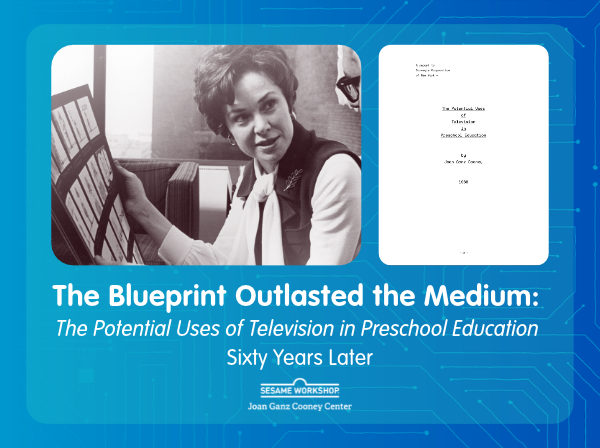
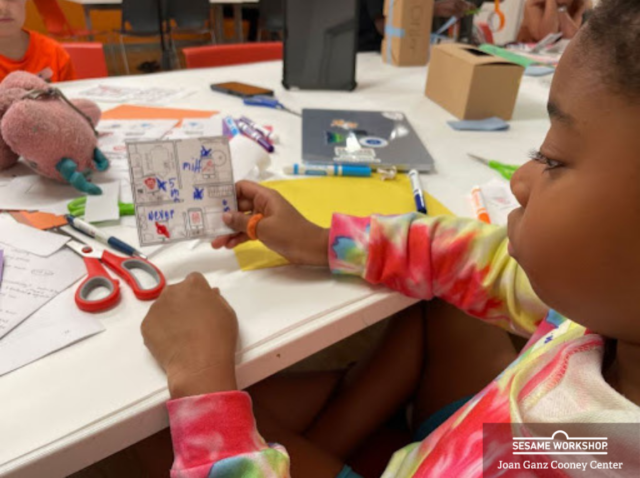
Sixty years ago, Joan Ganz Cooney asked whether television could do more than capture children’s attention—could it help them learn how to think? That idea became a hallmark of Sesame Street, where children were invited to sing along, answer back, and go make things. Today, children are not just watching media; they’re creating, designing, and shaping it.
This week, our contributors explore what it means to move from making media for children to making it with them—and why engagement and learning are not the same.

I first learned about the pioneering work of Joan Ganz Cooney 25 years ago while at TVOntario, a Canadian public broadcaster. Early in my career in children’s interactive media, I was already navigating many of the challenges her landmark report touches on: bridging the divide between academic insights and commercial production, the artificial distinction between education and entertainment, and finding meaningful ways to engage parents alongside their children.
Cooney’s report famously cites the 1960s critique of television as a “vast wasteland,” a sentiment that could certainly be applied to much of today’s interactive media. Just as critics did then, some today respond by dismissing the medium entirely or calling for bans and strict restrictions. Joan Ganz Cooney, however, looked at the reality of children’s media consumption and asked how it could be harnessed for the public educational good. Out of this she changed the lives of millions of children around the world.
The launch of the iPhone introduced unprecedented opportunities for new kinds of active media experiences, allowing young children to drive the play experience. Much of the early work in touchscreen play drew direct inspiration from the early days of children’s television. While the technology had leapt forward, the core principles of child development remained constant; it was up to a new generation of creators to find the common ground.
Today, the new frontier is artificial intelligence. If the iPhone was a rewiring of content consumption, AI represents a full-scale revolution. While the future impacts of AI on society and education are hard to foresee, we can once again take inspiration from Joan Ganz Cooney. We need to anchor ourselves in the timeless principles of child development and then ask how this technology can be used to create active learning experiences that promote curiosity alongside foundational skills.
As we mark the 60th anniversary of The Potential Uses of Television in Preschool Education, we find ourselves at a similar crossroads. We owe it to the next generation to champion Cooney’s visionary mindset, applying her rigorous yet creative approach to the complex and rapidly evolving landscape of modern children’s media.
Jason Krogh is an interactive media developer and designer best known as the founder and GM of Sago Mini, a Spin Master Digital Games studio. His work in the field of children’s digital products has been recognized with an Apple Design Award, Interactive Emmy and Kidscreen Award.