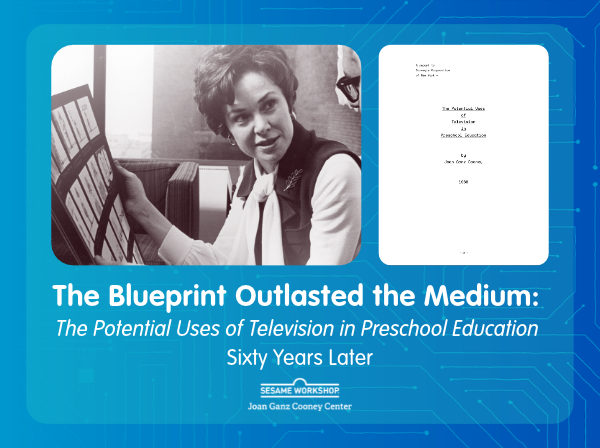
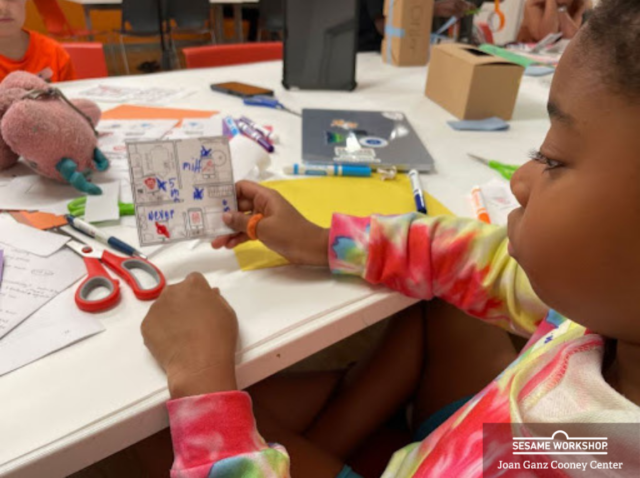
Sixty years ago, Joan Ganz Cooney asked whether television could do more than capture children’s attention—could it help them learn how to think? That idea became a hallmark of Sesame Street, where children were invited to sing along, answer back, and go make things. Today, children are not just watching media; they’re creating, designing, and shaping it.
This week, our contributors explore what it means to move from making media for children to making it with them—and why engagement and learning are not the same.

It has been a privilege to hold Joan Ganz Cooney’s guiding principles as the inspiration for our work for all of Sesame Street media. So many of those principles still hold true, but the landscape in which children encounter content today is unrecognizable next to the 1960’s. In fact, it has arguably shifted more in the last decade than in the five decades before it. She wrote for a moment when one television could gather an entire family in a single room with a shared experience; today, a child in that same house might be having a very individual experience while other members of the family are on their own devices.
Children’s media has since exploded into a glut of brands, IP, and characters, and the clearest evidence of the report’s staying power is that anything considered quality content now treats Joan’s original principles — teach children how to think, not what to think; make learning active rather than passive; entertain and educate in the same breath — as baseline requirements rather than a differentiator.
In a moment where algorithms direct so much of the way that content is produced and served to children, today’s landscape would benefit from research that could turn algorithms on their head to incentivize content beyond engagement metrics — optimizing not for watch time but for a core set of cognitive and socio-emotional skills. The measure of success wouldn’t be a completed video; it would be to inspire curiosity or enhance social emotional and basic skills.
If Mrs. Cooney once set out to make children ready for school, and largely succeeded, today’s version of her project would aim to make children ready for a fast-changing world — adapting content to individual needs instead of the needs of platforms, brands, and watch times.
Sal Perez is the Executive Producer and Vice President for Sesame Street Productions, overseeing the creative direction and production teams for Sesame Street, The Not-Too-Late Show with Elmo, and all other global content experiences across broadcast and digital platforms for the brand.