In the 1960s, FCC Commissioner Newton Minow famously called the television landscape “a vast wasteland.” With the rise of algorithmically driven video feeds, AI-generated content, and an endless stream of choices, how does today’s media landscape compare? Our contributors consider what it means to pursue quality in an environment shaped by commercial incentives and powerful new technologies—and why retreating from technology isn’t enough.

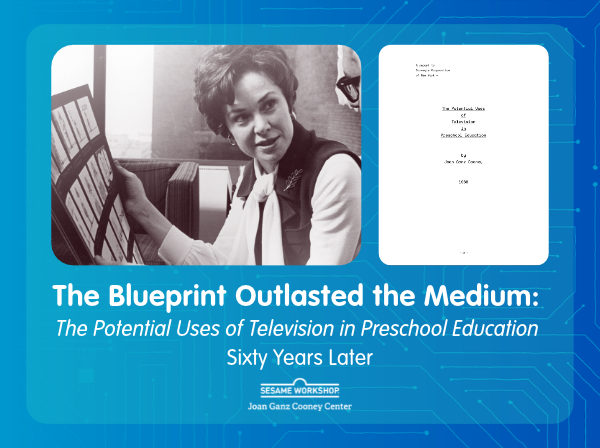
In 1942, E.B. White, author of Charlotte’s Web, predicted that in television, “we shall discover a new and unbearable disturbance of the modern peace or a saving radiance in the sky.” Joan Ganz Cooney’s visionary 1966 proposal propelled the development of Sesame Street, which realized television’s potential as a “saving radiance in the sky”. Her radical idea was that television, to which children were powerfully drawn, could teach them letters and numbers. Her goal was to close the school-readiness gap for “disadvantaged” children who did not have access to preschool that placed “great emphasis…on emotional and social adjustment”, providing “free play, singing, games, stories, and conversational exchange.” Her “Recommendations for a Television Series,” when followed and evolved by several generations of thoughtful educators and talented television producers (and puppeteers!), have given rise to several generations of children who were not only school-ready with literacy and math skills, but prosocial citizens in a diverse, culturally rich world.
Sesame Street’s success triggered a wave of children’s television that, like Sesame Street, used the techniques of television commercials, “frequent repetition, clever visual presentation, brevity and clarity”, to grab viewership. Much of it was made more quickly and less expensively by abandoning Sesame Street’s rigorous, research-based education, but was marketed to parents by slapping on the educational label. As technology evolved, such “educational” content was easily adapted to mobile, intuitively controlled devices that many parents and caregivers used as guilt-free electronic babysitters. Mrs. Cooney’s groundbreaking vision for television brilliantly solved the school-readiness educational crisis of the 1960s but did not anticipate its technological descendants’ evolution into an “unbearable disturbance of the modern peace”. If she were traveling the country today, she would see very young children pacified by tablets and smartphones, isolated from each other in their individualized feeds, receiving AI-generated answers rather than stimulating questions, learning consumerism. From the educational and child developmental experts she interviewed, she would hear concern, not hope.
Joan Ganz Cooney’s optimism for television as an educational tool 60 years ago feels deeply ironic in 2026. Her call for parent involvement, a child’s first educator, has been stymied by “technoference” and “phubbing”. Many parents have outsourced their primary teaching role to AI as more capable of generating the answers required in a “teach to the test” educational environment, ignoring the fact that effective teaching and learning are highly relational, high-touch connections between two caring humans. The concept of screen time is obsolete, unmeasurable because we constantly move seamlessly between the digital and the physical. What we can measure, however, is intentional non-screen time—time to daydream, to question, to learn, to connect, to understand —time and mind space that we deny ourselves when we give our attention to screens. What we must quantify going forward is not what children know but what they want to know, their curiosity, creativity, and joy of learning. Today, her radical proposal would guide us toward the emerging media of free play, singing, games, and in-person conversational exchange.
Michael Rich, MD, MPH is Associate Professor of Pediatrics at Harvard Medical School and of Social and Behavioral Sciences at Harvard T.H. Chan School of Public Health, Director of the Digital Wellness Lab, and practices Adolescent Medicine at Boston Children’s Hospital. Dr. Rich is the Founding Director of the first evidence-based medical program addressing physical, mental, and social health issues associated with digital technology, the Clinic for Interactive Media and Internet Disorders (CIMAID). Author of The Mediatrician’s Guide: A Joyful Approach to Raising Healthy, Smart, Kind Kids in a Screen-Saturated World, Dr. Rich offers research-based, encouraging, and practical answers to parents’, teachers’, and clinicians’ questions about children’s media use and the positive and negative implications for their health and development. Understanding the power of screens to engage, connect, and change us all, he is bringing together pediatricians and software engineers, educators and designers, psychologists and screenwriters in the Digital Wellness Lab to synergize in researching, responding to, and innovating a digital environment in which we can raise healthy, smart, productive, and kind children.