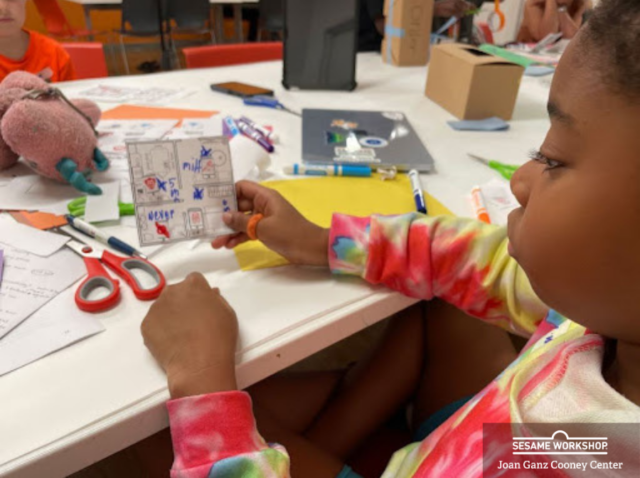
“You see a Stone Lion blocking your path.”
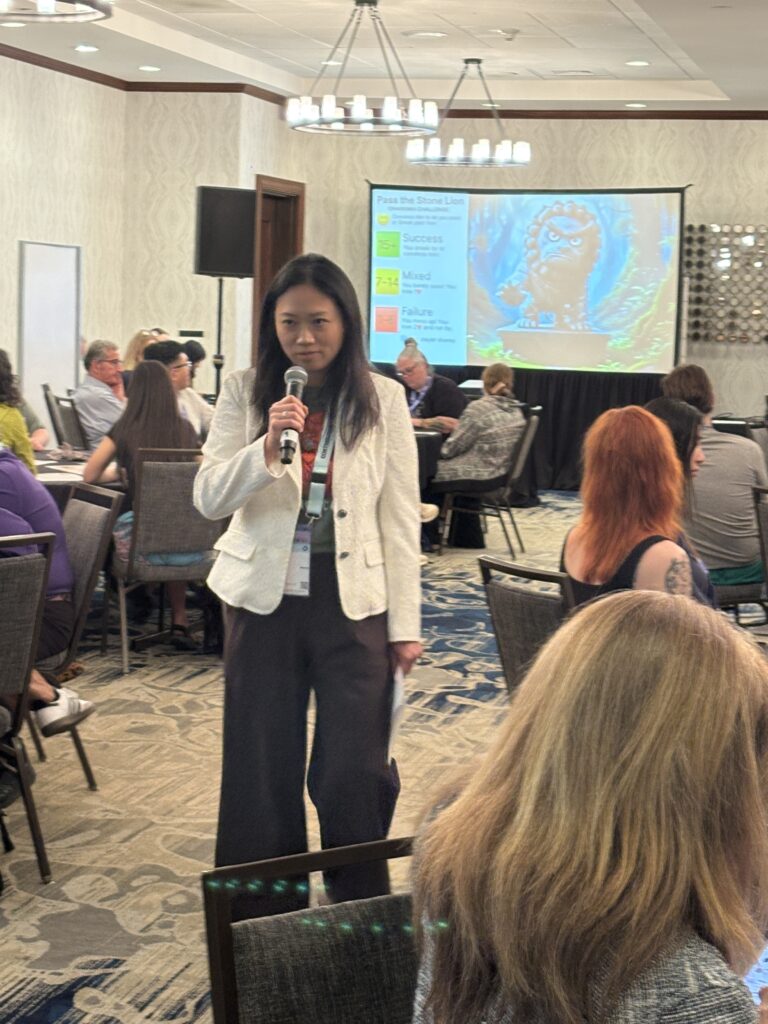
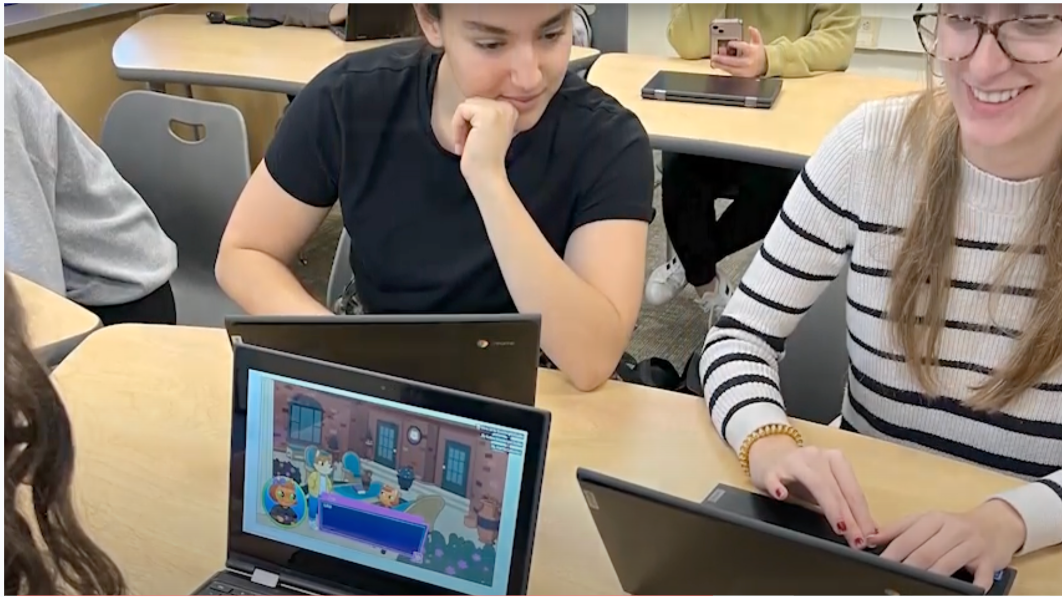
At SXSW Edu, a room full of educators leaned in as they approached the first NPC (nonplayer character) of the game.
“Wait… what do we do?”
“Can we talk to it?”
Within minutes, they were collaborating, storytelling, and problem-solving—many for the first time in a tabletop role-playing game (TTRPG).
I came into this work as a parent and a career educator. And now, with guidance from the Joan Ganz Cooney Center, I’ve become a game designer. My team’s digital product, Quest Craft, is a platform of culturally inclusive TTRPGs that build kids’ creativity and social skills through collaborative play.
Across all three roles, I face the same question almost daily: What digital experiences should kids have access to—and why?
Most of us—whether we are parents or game designers—rely on instinct. Is there anything inappropriate? Are kids feeling accomplished, or melting down, when gameplay is over? Does it seem OK in the moment, and is this app helping or harming in the long term? We are making decisions constantly, but without a shared framework, we are often guessing.
That is why the Responsible Innovation in Technology for Children (RITEC) framework matters (learn more about the RITEC-8 components here). It gives adults a way to evaluate experiences for kids with more meaningful intention. At our SXSW EDU workshop, “Level Up! Role-Playing Games for Well-Being in the Classroom,” the Cooney Center’s Sarah Jacobstein opened the session by asking the educators in the room, “What does well-being mean to you?” It quickly became clear: Without a shared definition, we have ideas, but no usable framework.
In my own home, RITEC has become actionable. After I participated in the Joan Ganz Cooney Center’s Well-Being by Design Fellowship, my 12-year-old now knows that if he wants to try a new video game, he has to give me his RITEC assessment first. It helps him reflect on how a game makes him feel and what it’s actually doing for him.
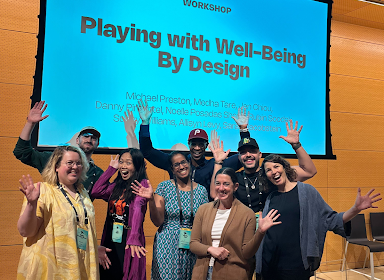
At our SXSW EDU workshop, we dove deep, applying the RITEC framework to one of the most promising game-based learning methodologies for social-emotional learning: tabletop role-playing games. Along with the Cooney Center and Quest Craft, the workshop was co-hosted by Dr. Elizabeth Kilmer, licensed clinical psychologist and author of Therapeutically Applied Role-Playing Games. She shared research about how TTRPGs can increase engagement and reduce stress, while supporting social connection, problem-solving, and creativity, especially for marginalized youth.
It’s a lot to explain, so we led the crowd through a game to help everyone learn by doing.
Participants stepped into Battle the Nian Monster, a Quest Craft TTRPG experience inspired by an ancient Chinese folk tale and the ideas of our 4th-grade co-designer that we’ve brought to partner classrooms and libraries.
At the start of the session, every group faced the same challenge: A Stone Lion blocking their path to finding a fearsome Chinese monster.
No two groups solved it the same way.
One group approached gently, using their character’s power to understand ancient artifacts. Another group, playing the arrogant “Monkey Prince” character, rushed forward and smacked the Lion with his tail. The group role-playing an aspiring K-Pop musician character decided to draw on their musical ability and play soothing melodies instead of fighting.
Participants were immersed in the game’s world, whether negotiating with a Stone Lion, debating how to divide resources, or making choices under uncertainty. The same situation gave way to very different choices, highlighting what autonomy and imagination look like in practice.
After everyone experienced how role-playing gameplay worked, we mapped that experience back to the RITEC Dimensions.
The connections they made were immediate and specific. Participants identified how Relationships were strengthened through “collaborating and stepping into new roles that sparked discussion” and that they felt Autonomy through “open-ended creative decision making with some guidelines and constraints.”
When reflecting on Competence, groups pointed to critical thinking, using unique strengths, and working as a team. One group called out that “opportunities to practice storytelling and communication skills” directly support “literacy competence,” making clear connections to academic standards.
As a game designer and RITEC enthusiast, it was gratifying to hear these teachers feel and reflect on the Quest Craft team’s intentional design choices based on the RITEC framework.
By the end, educators in the room were already mapping this to their own classrooms, including history simulations, literacy development, and STEAM problem-solving.
RITEC gives us a strong framework for designing with youth well-being in mind. But frameworks don’t implement themselves. Designers need to understand classroom realities, and educators need a clear way to evaluate whether tools support student well-being—not just academic outcomes or brain breaks.
Quest Craft has demonstrated that integrating RITEC early on–I participated in the JGCC Fellowship when we were still developing the Quest Craft game prototype–makes it easy to translate RITEC principles into a playable system, particularly when it’s done in concert with youth co-designers.
Coming out of this SXSW EDU workshop, nearly 100 educators expressed interest in TTRPGs and many said they were ready to use RITEC-informed TTRPGs in the classroom. (In her exit ticket, one educator wrote, “I’m going to start this immediately!!!”) We’re now onboarding these folks into the Quest Craft community.
If we want well-being by design to matter, we need to build games, tools, and systems that people can actually use. And we need continued collaboration between researchers, designers, and educators to make frameworks like RITEC actionable in real settings like classrooms and homes to reach kids at scale.
RITEC gives us the principles. Now we need to design experiences where kids can actually live them—through their own decisions, voices, and stories.
 Jen Chiou 趙燕妮 (she/her) is the founder of CodeSpeak Labs, a computer science education social enterprise that empowers K-12 students to use technology to build a better world and a 2025 Well-Being by Design Fellow.