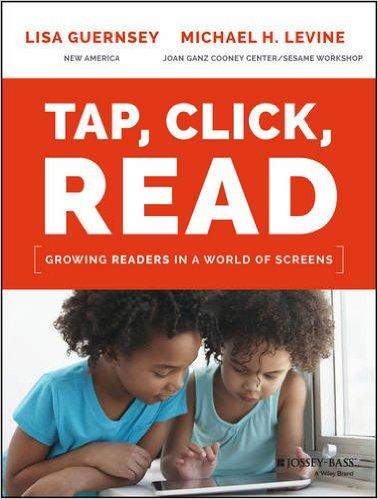
In 2015, the book and multimedia project Tap, Click, Read: Growing Readers in a World of Screens offered an optimistic vision for a symbiosis of media, technology, and literacy. Authored by Michael Levine, founding director of the Joan Ganz Cooney Center and Lisa Guernsey, a senior director of education policy at New America, the book combined insights gathered from early childhood educators, cognitive development experts, literacy and media researchers, and technology developers, with stories of initiatives that could be stepping stones to a future where “screen time” reinforced and enriched reading instead of undermining it.
Tap, Click, Read reflected a world before the launch of ChatGPT and before the disruption, trauma, and learning loss of the Covid-19 pandemic. While there have been exciting new developments in literacy edtech and emerging methods of co-designing edtech tools with insights from both kids and the “science of reading,” the last 10 years have also featured stubbornly low literacy rates and widening achievement gaps. Rather than facing these challenges from a position of unity and strength, the worlds of education research, philanthropy, and policy are currently caught in a maelstrom of political tension and funding cuts.
These crosscurrents added urgency to the discussions that took place on October 27, 2025, at “Growing Readers in a World of Screens and AI”—a day of panels and presentations meant to take stock of the preceding decade and to plot a way forward. The event was co-hosted by New America, the Joan Ganz Cooney Center at Sesame Workshop, and the Campaign for Grade-Level Reading. The mood was subdued but determined, reflecting the largescale claw back of federal education investment at a time of widening achievement gaps, and the sense that much of the edtech boom was neither backed by rigorous research nor designed for the students most in need of support.
Nevertheless, participants recognized that an abundance of literacy expertise, technological know-how, and good intentions to do what’s best for kids remained to be tapped. New models for collaboration between researchers, educators, edtech developers, and policy makers were emerging, and calls were made to combine forces, to plan, and to think strategically, even as the world—both in education and beyond—seems to lurch from crisis to crisis.
Looking Back, Looking Forward
New America’s president and chief transformation officer, Paul Butler, opened proceedings by welcoming attendees to the nonprofit’s Washington, DC headquarters where the event took place.
“We are ready,” he said. “We are ready to dive into some tough questions and to call for approaches to research and development that we need urgently.”
Butler’s remarks were followed by the day’s first panel reflecting on the 10 years since the publication of Tap Click Read, featuring Levine, Guernsey, and Ralph Smith, founding managing director of the Campaign for Grade-Level Reading. In 2012, Smith’s organization offered the original funding for the research that would grow into the book.
“We spent a lot of time listening to parents,” he recalled. “They were overwhelmed by the proliferation of tools and products online. They couldn’t figure out where to start.”
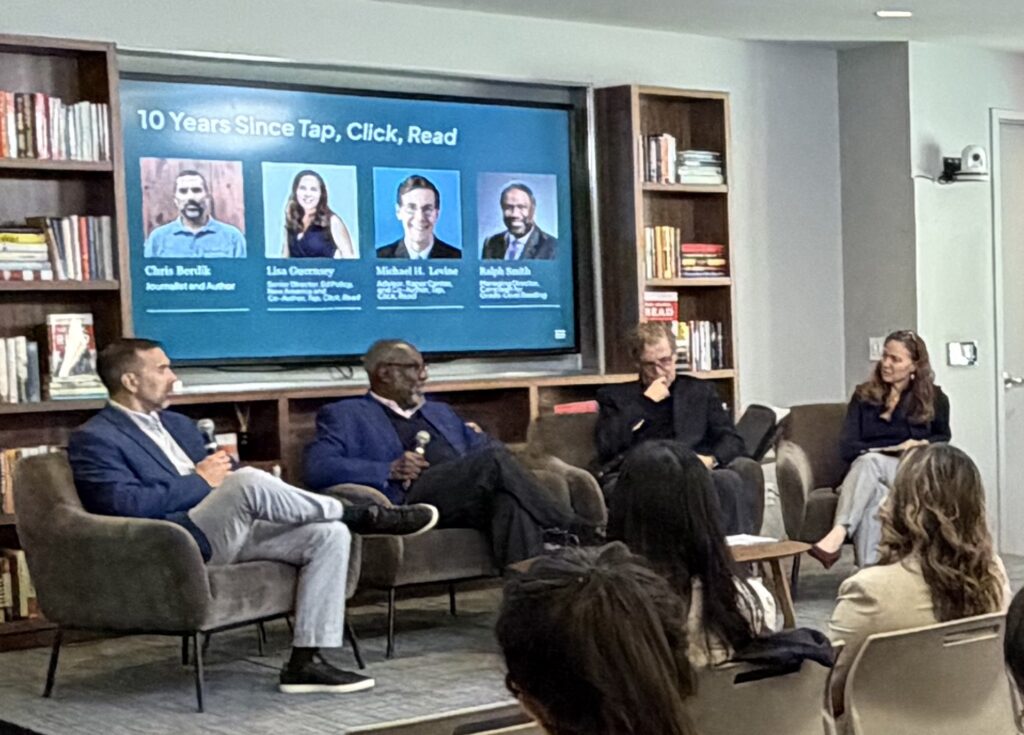
Guernsey and Levine lamented the lack of progress toward the future their book envisioned. Levine noted that the literacy struggles of America’s children, which they’d labeled a “quiet crisis” in 2015, had now become a “very loud crisis.” He mentioned several hopeful trends, such as educators’ and policy makers’ growing embrace of the science of reading along with edtech startups innovating ways to close persistent literacy gaps. Nevertheless, he said, “let’s be honest about what we’re facing—the emasculation of education R&D, a lack of interest in regulating new technologies like AI, and a lack of leadership from policy makers, especially at the federal level, to do something about the reading crisis in America.”
A New Push for Edtech Collaboration
After the opening panel, Angelica DaSilva, a Cooney Center fellow for literacy and technology, gave a talk titled “Translating the Science of Reading to Educational Technology” that connected decades of research on best practices for reading instruction with her experience as a literacy consultant for the Cooney Center’s Sandbox for Literacy Innovations, a three-year initiative supported by the Walton Family Foundation.
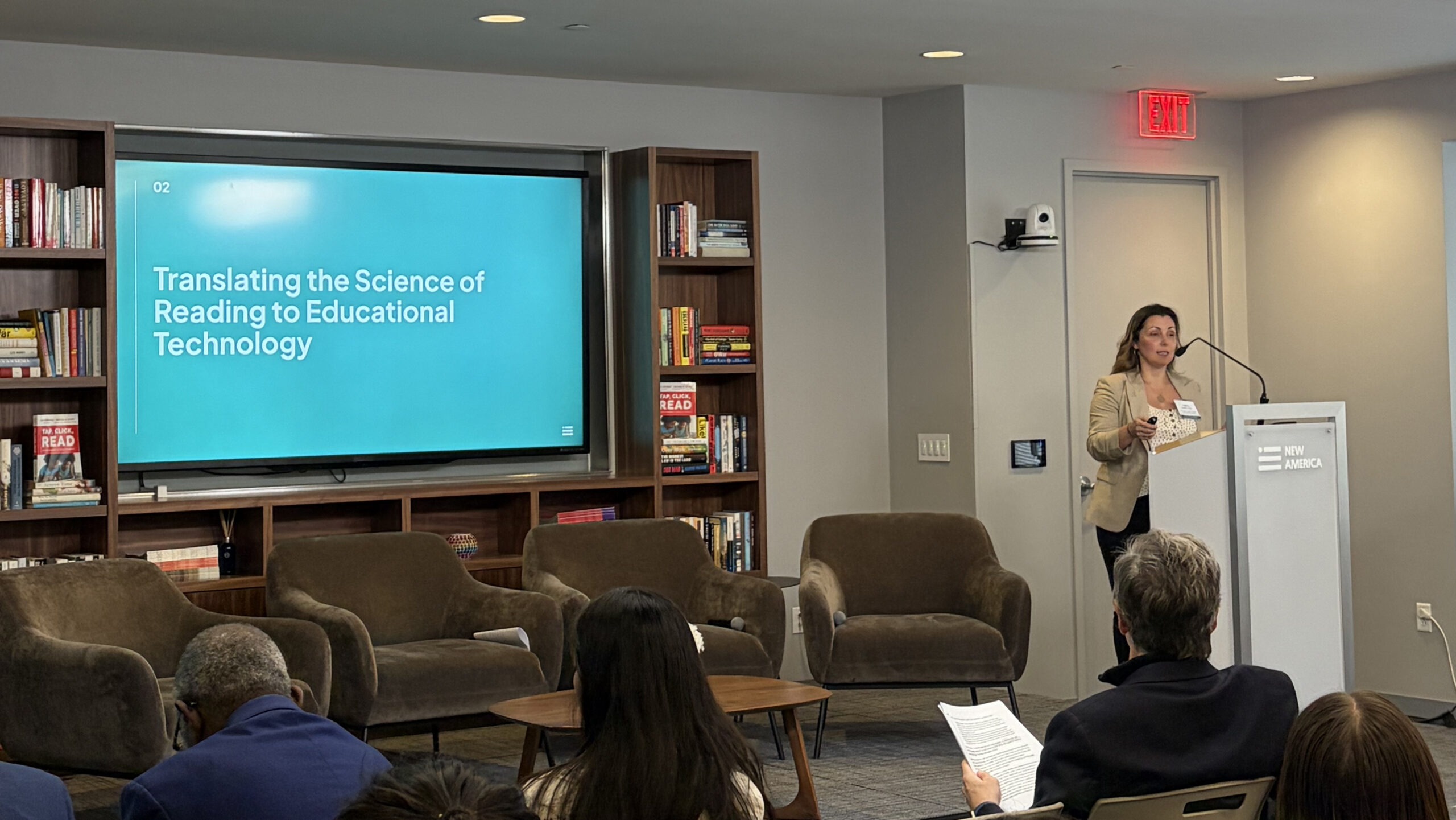
According to DaSilva, the science of reading is often mischaracterized simply as phonics. While the ability to decode words is a foundational reading skill, she noted, “decoding is not the goal of reading; Comprehension is the goal.” This core idea led to the first challenge she outlined for literacy edtech—to offer a more holistic approach to reading pedagogy that doesn’t stop at phonics.
The next challenge was to go beyond one-size-fits-all apps designed for the “average student,” which is a statistical construct and not the reality in classrooms filled with a wide spectrum of learners.
“We should be designing for inclusion from the get-go, rather than designing first for the ‘average student’ and trying to add inclusivity later,” said DaSilva. Lastly, she called for more innovations that supported teachers, such as data-informed dashboards and personalized lesson-plan recommendations, as well as more efficacy studies and external validation of literacy edtech.

Meeting these challenges will require a lot more partnering between researchers, product designers, educators, and kids, a collaborative approach at the heart of the Sandbox initiative, which took center stage in the next panel. Moderator Medha Tare, the Cooney Center’s senior director of research, was joined by representatives from three edtech startups partnering in the Sandbox—Youngna Park, product lead for Sago Mini Studios, Dan Lee, head of product for Lirvana Labs, and Drew McCann, head of learning for LitLab.
Tare began by introducing the three components of the Sandbox partnerships—literacy consultations based in the science of reading, whole-child workshops focused on learner variability and universal design for learning, and co-design sessions that Tare differentiated from the more-common practice of playtesting in which kids offer feedback on products that are nearly.
“Co-design means kids and adults are on the floor together, brainstorming together, and ideating together,” she explained. “It is not an observational research session in the traditional sense.”
The developers then shared insights from their time in the Sandbox, such as supporting the cognitive load of young learners by bolstering the confidence of young readers, ensuring that phonics games adhered to the scope and sequence of an established literacy curriculums, and ratcheting up engagement with an educational app by empowering young people to customize the app’s characters, settings, or functionality.
A Call to Action
For the day’s final panel, Guernsey returned to the stage to lead a discussion titled “Ensuring Tech Helps, Not Hurts, In Learning to Read- A Call to Action” with An-Me Chung, director of New America’s Teaching Learning & Tech Program, Sara Schapiro, executive director of the Alliance for Learning Innovation, Michelle Kang, CEO of the National Association for the Education of Young Children, and Kris Perry, executive director of Children and Screens at the Institute of Digital Media and Child Development.

The panel began with Schapiro pointing out the current vacuum of federal leadership in edtech policy, noting the Trump administration’s deep cuts and grant cancellations to programs funded by the Institute of Education Sciences, the Department of Education’s statistics and research arm. Still, she highlighted a potential silver lining to its destruction, which is the opportunity to create a new blueprint for rebuilding a future R&D infrastructure that better coordinates federal, state, and local efforts and focuses more on delivering practical solutions for the field.
Likewise, Chung both recognized the urgency of the moment and stressed the need to devote significant thought and energy into long-term strategizing and systems building, such as a broader push to teach AI literacy. Finally, Perry pointed out that across decades of educational research, one thing was consistently found to be good for kids—high quality, in-person instruction—and she urged the audience not to be swept up by pressure to use AI and other digital technologies at every stage of learning or to solve every pedagogic challenge.
“We have to slow down and think about developmentally aligned standards,” she said. “We need edtech, but we also need to give kids more time outdoors. We need to invest in more experiences and places for families and adolescents to go that are not tech driven, so there is more balance in peoples’ lives.”
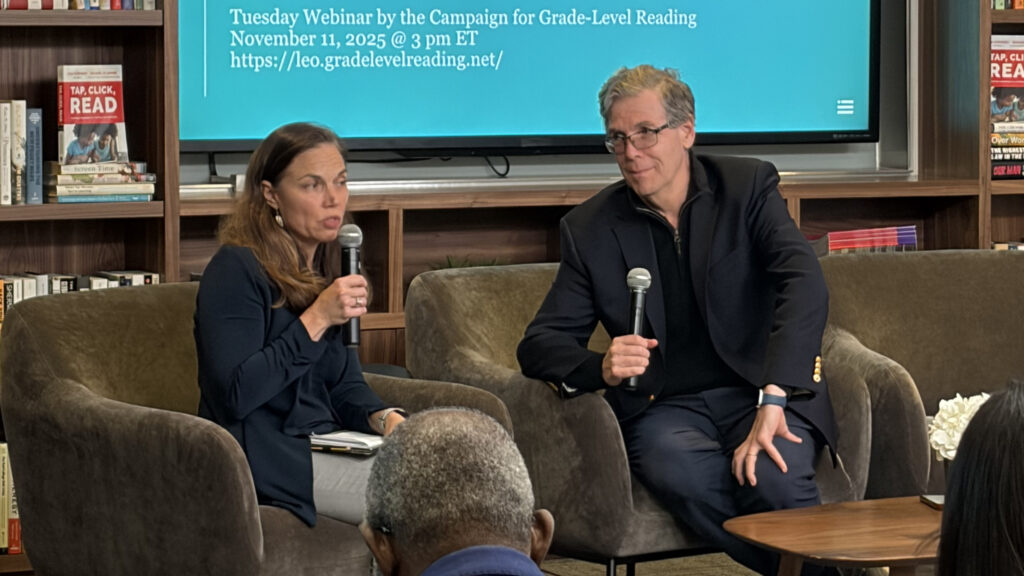
After the panel, Levine joined Guernsey for some final reflections on how to meet the current moment. They both reiterated the need for more urgent cross-disciplinary efforts to tame the digital wild west and harness the expanding power of technology to support teachers, parents, and students and find a way out of our longstanding literacy crisis.
“We’ve been tapping and clicking a lot more than we’ve been reading in recent decades,” admitted Levine. “This is an urgent moment. But we also need to be planful in what we do here. We need policymakers at every level. We need philanthropists. And we need product designers especially, with the ability to scale things quickly and start putting together new blueprints, new visions.”
Guernsey recalled that their book envisioned alternative futures for the “class of 2030,” children who were preschoolers in 2015 but were now just five years from high-school graduation. The decade had passed swiftly and every year that the literacy crisis continued unresolved, its human toll mounted.
“There are still so many kids today without somebody there to help them learn to read,” she said. “We have got to be there for these kids. We’ve got to mobilize and get ourselves together so they aren’t lost in mindless technology but are supported by an ecosystem of caregivers, teachers, parents, libraries, and schools. We can’t give up.”