A recent WIRED article, “Stop Saying Kids Can’t Read” raises an important issue in our current conversation about literacy. Mississippi has received national attention for substantial gains in elementary reading. But the picture looks different by the time these students reach middle school. The article describes eighth-grade students who can read the words on the page but struggle with comprehension, stamina, and sustained engagement with text. The distinction matters because reading words and comprehending text are not quite the same thing.
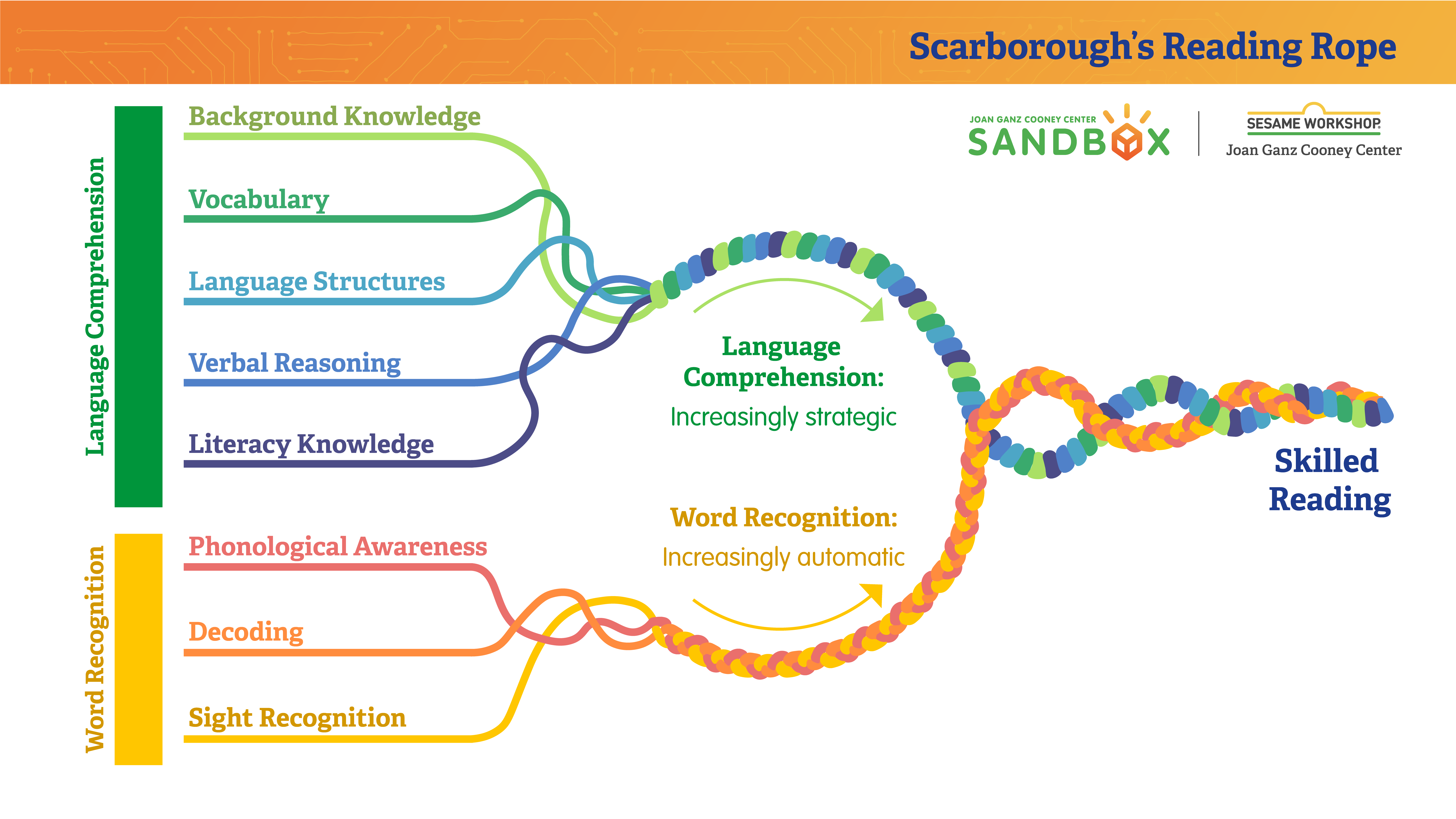
The Simple View of Reading (Gough & Turner, 1986) conceptualizes reading comprehension as the product of decoding and language comprehension. Scarborough’s Reading Rope (Scarborough, 2001) makes the same idea more visible: skilled reading requires word recognition alongside vocabulary, background knowledge, language structures, verbal reasoning and other forms of language comprehension.
Phonics instruction, then, is not a solution to reading comprehension. It is a solution to an essential part of it: word reading.
The bottleneck changes
For beginning readers, decoding is normally the bottleneck. Children simply cannot understand a written sentence they cannot read. But as children get older and become more proficient word readers, the relationship between decoding and comprehension weakens—while language comprehension becomes increasingly important (García & Cain, 2014; Lervåg et al., 2018).
This is somewhat intuitive. Early texts often center around concrete things children already know from their lived experiences in the real world. Older students, on the other hand, encounter unfamiliar vocabulary, complex syntax, figurative language, abstract concepts that are new to them, implied relationships between ideas, and arguments that extend across sentences, paragraphs, and pages. Reading words accurately is still crucial, but increasingly insufficient.
Observational evidence suggests that phonics implementation reforms (aka “science of reading” policies) may, in some early-elementary classrooms, be producing a disproportionate emphasis on code-focused instruction. In one recent study of K-1 Tier 1 instruction, phonics accounted for nearly 60% of observed instructional time, while only about 7% was devoted to comprehension (Dahl-Leonard et al., 2026). This contrast is notable given broader observational evidence showing that comprehension instruction already occupies a relatively small portion of elementary literacy instruction (Capin et al., 2025).
The purpose of learning to decode efficiently is to unlock access to connected text. Through that access, children can continue developing language, knowledge, fluency, comprehension, and perhaps even an identity of someone who reads. But for that to happen, children actually need to read. They need to access and engage with authentic texts. Lots of them. Volume matters!
This is where things start getting complicated. NAEP data show substantial declines in reading for pleasure over time. At the same time, recent observational research suggests that some early literacy classrooms may allocate a large share of instructional time to foundational skills while minimizing authentic book reading time (Campbell, 2021; Dahl-Leonard et al., 2026). As Ms. Belinda Juergens, a teacher in Tennessee, observes: “When we were kids, we fell in love with stories: Nancy Drew, Trixie Belden, the Boxcar Children, Charlotte and Wilbur, etc. Reading excerpts of texts just does not invoke the same feelings in kids.”
When instruction becomes infinitely scalable
None of this is fundamentally a technology problem. Schools could overemphasize or deemphasize discrete skills before tablets, adaptive programs, or generative AI existed. The concern is what happens when technology is layered onto instructional systems.
Educational technology is extraordinarily good at scaling what it’s programmed to do, and generative AI pushes that capacity further by producing nearly endless passages, questions, examples, exercises, and feedback (Mittal et al., 2024). However, scalability is agnostic to quality: AI can just as easily make a questionable instructional decision more efficient.
Consider decodable texts, for example. They serve an important but temporary instructional purpose by giving beginning readers opportunities to apply recently taught phonics patterns in connected text. A recent meta-analysis examining the efficacy of decodables found only a small positive effect in word reading and a moderate effect in pseudo-word decoding, concluding that decodables are useful alongside other reading materials (Murphy Odo, 2024). AI empowered tools remove the practical ceiling on how many controlled or decodable texts a curriculum can provide, seemingly enabling more personalization and practice.
However, there is a foundational issue at stake. The purpose of decodable reading is not to keep children reading increasingly large quantities of decodable text. It is to help them consolidate the alphabetic system sufficiently so they can devote less attention to decoding and engage with the meaning, language, and knowledge contained in authentic texts. The foundational issue, then, is what educational problem we are trying to solve: children’s difficulty reading authentic text or a shortage of decodable texts? Research up-to-date has not determined the latter to be a problem.
The real test of foundational skills instruction
The real test of any successful foundational skills program is transfer, not unlimited practice. The real question is “Can children take what they learned and use it to read authentic texts?”
Asking the right question changes how we evaluate the success of a product. For example, if the goal is for children to read real, authentic grade-level sentences and texts, the measure of a foundational skill product should not be based on internal product data of how much practice a child completed or how many levels they passed. Rather, success should be defined by children’s ability to use the skills to read authentic material. In other words, success is no longer needing the product. A truly effective program would move more kids towards that goal more quickly compared to those not using their product.
Instead, generative AI tends to create the possibility of optimizing the practice environment so effectively that students can remain inside it longer, indefinitely. We risk building an instructional enclosure in which children really master the art of practicing.
That is one of the risks I see with AI-enabled tools in literacy instruction. AI does not merely automate existing educational activities. It can magnify well-intentioned instructional decisions in unintended ways.
Learn more about edtech and research around literacy education: Translating Literacy Research to Edtech: What We Have Learned to Support Product Development
References
Campbell, S. (2021). What’s happening to shared picture book reading in an era of phonics first? The Reading Teacher, 74(6), 757–767.
Capin, P., Dahl-Leonard, K., Hall, C., Yoon, N. Y., Cho, E., Chatzoglou, E., Reiley, S., Walker, M., Shanahan, E., Andress, T., & Vaughn, S. (2025). Reading comprehension instruction: Evaluating our progress since Durkin’s seminal study. Scientific Studies of Reading, 29(1), 85–114. https://doi.org/10.1080/10888438.2024.2418582
Dahl-Leonard, K., Hall, C., & Lee, D. (2026). Examining the effects of Tier 1 small-group reading instruction on early-elementary students’ reading outcomes. Reading and Writing. Advance online publication. https://doi.org/10.1007/s11145-026-10778-5
García, J. R., & Cain, K. (2014). Decoding and reading comprehension: A meta-analysis to identify which reader and assessment characteristics influence the strength of the relationship in English. Review of Educational Research, 84(1), 74–111. https://doi.org/10.3102/0034654313499616
Gough, P. B., & Tunmer, W. E. (1986). Decoding, reading, and reading disability. Remedial and Special Education, 7(1), 6–10. https://doi.org/10.1177/074193258600700104
Lervåg, A., Hulme, C., & Melby-Lervåg, M. (2018). Unpicking the developmental relationship between oral language skills and reading comprehension: It’s simple, but complex. Child Development, 89(5), 1821–1838. https://doi.org/10.1111/cdev.12861
Mittal, U., Sai, S., Chamola, V., & Sangwan, D. (2024). A comprehensive review on generative AI for education. IEEE Access, 12, 142733–142759. https://doi.org/10.1109/ACCESS.2024.3468368
Murphy Odo, D. (2024). The use of decodable texts in the teaching of reading in children without reading disabilities: A meta-analysis. Literacy, 58(3), 267–277. https://doi.org/10.1111/lit.12368
National Center for Education Statistics. (2025). NAEP long-term trend assessment: Reading—Student experiences. U.S. Department of Education, Institute of Education Sciences.
Scarborough, H. S. (2001). Connecting early language and literacy to later reading (dis)abilities: Evidence, theory, and practice. In S. B. Neuman & D. K. Dickinson (Eds.), Handbook of early literacy research (Vol. 1, pp. 97–110). Guilford Press.